Tampilkan postingan dengan label another ship. Tampilkan semua postingan

Minggu, 15 Februari 2015

HNMLS De Ruyter

Hello All! Now we gonna talking about my favorite ship De Ruyter! HNLMS mean (maybe) High Netherlands Majesty Ship in English. Now we start now....


 De Ruyter was originally intended to displace only 5,250 tons, with armament of six 5,9 inch (150mm) guns in three twin turrets, one forward and two aft. It was recognised that this was to small for the needs of the East Indies, so the design was enlarged to increase the speed and allow a catapult to be worked in. At same time the opportunity was taken to add a single superfiring 5.9 inch (150mm) gun forward. It would not have been possible to fit a twin turret without enlarging the ship still further. This gave De Ruyter the same broadside as Java and Sumatra, two slightly larger Dutch cruiser laid down in 1916.
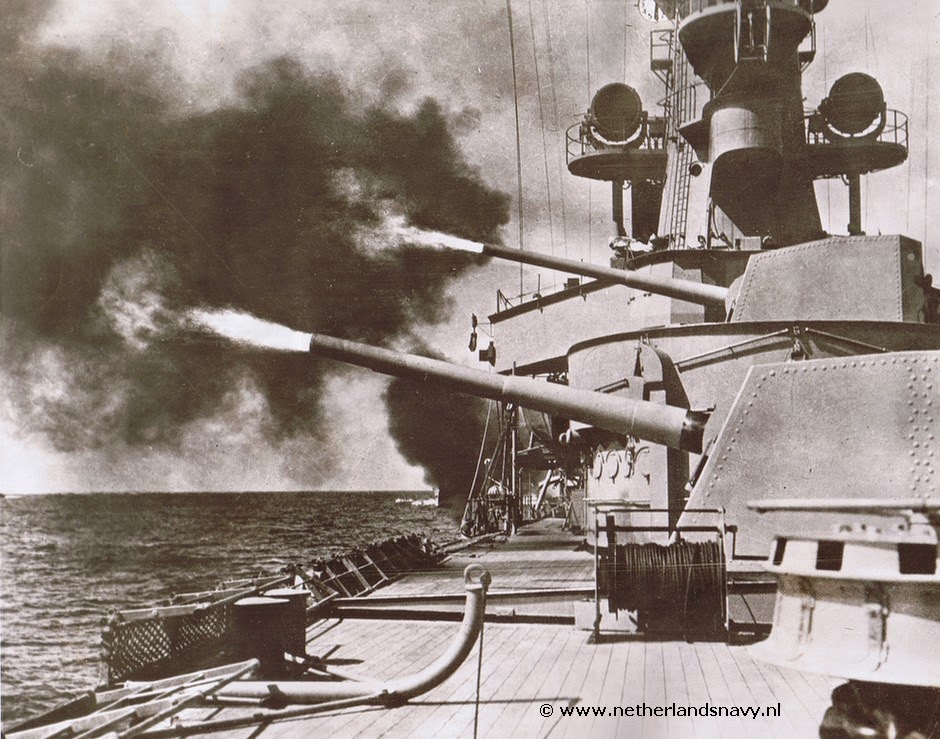
De Ruyter on practice 


 De Ruyter was specifically intended for service in the Dutch East Indies, and habitability was excellent. There was a tower bridge reminiscent of the German Panzerschiff, and smoke deflectors on the funnel gave her an ungainly appearance. Weight was saved by having no torpedoes or heavy anti-aircraft armament, but the 40mm anti-aircraft guns were fitted with advanced power mountings with excellent fire control.
 
  She was hit by one 24in (610mm) type 93 torpedo fired by Japanese cruiser Haguro, and sank two hours later. over 200 of the crew were killed and Admiral Kareel Doorman choose to remain aboard and follow the old tradition of all the ship's captain and sunk with his ship.
Rear-Admiral Karel Doorman


Service Career De Ruyter
1937 (Jan-Mar) To Dutch East Indies
1937(May) Joined East Indies squadron
1940(Jan-Feb) Refit and Repairs to turbines at Surabaya
1941(Dec-Feb 1942) Patrol and convoy escort
1942(27 Feb) Allied Flagship at Battle of the Java Sea
19429(27 Feb) Hit by Japanese torpedo and sunk in two hours

Displacement
Standard tons (tonnes)            6,442 (6,545)
Full load tons (tonnes)            7,548 (7,669)

Dimension
length             (wl)                   552.2ft (168.3m)
                       (oa)                   561ft    (171m)
beam                                        51.5ft   (15.7m)
draught                                    16.4ft   (5m)

Armament
guns
5.9inch (150mm) 50 Cal             7
40mm                                          10
0.5inch (12.7mm))                       8

Armour
side (belt)                                     1.2-2 inch (30-50mm)
deck                                              1.2 inch (30mm)
main turrets                                  1.2 inch (30mm)
barbettes                                       1.2 inch (30mm)

Machinery
boilers (type)                               Yarrow
            (number)                          6
engines (type)                              Parsons single reduction geared turbines
shaft                                             2

Total SHP
designed                                       66,000

Fuel Capacity
oil tons (tonnes)                           1,300 (1,320)

Performance
designed                                       32 knots
range                                            8,100 miles (6,800nm) @ 12 knots
Crew                                            435


Ship:                          De Ruyter
built:                          Wilton-Fijenoord, Schiedam
ordered:                     1 Aug 1932
laid down:                 1 Sept 1933
launched:                  11 May 1935
completed:                3 Oct 1936
fate:                           Sunk 28 Feb 1942

Sabtu, 14 Februari 2015

SMS Nassau (updated)

I'm so sorry because yesterday i forgot to put the characteristic of  the ship and now has updated
Now we talking About SMS Nassau. SMS can mean Ser Majesty Ship in English if you already now about this well good then.


SMS Nassau
 Not until the Braunschweig class, built between 1901 and 1906, did the German produce a first-class battleship comparable with those build aboard. These where followed by slightly improved version, the Deutschlands, built between 1903 and 1908. when the British battleship Dreadnought appeared, the German designers were not ready to build a comparable vessel. Their first all-big-gun ship, the Nassaus, were not laid down until nine months after Dreadnought had been completed, and were simple enlarged Deutschland. They use slightly more powerful version of the Deutschland reciprocating machinery, and this prevented turrets being mounted in the center of the ship as in turbine-powered Dreadnought. The Nassaus therefore adopted the very wasteful arrangement of four wing turrets, and they retained the Deutschland's 11 inch  (280mm) gun. The German preferred to use a small shell with high muzzle-velocity. The weight saved by not using a larger calibre gun was utilised to improve the protection. in this respect the Nassaus were superior to their British contemporaries, though as with most ship with wing turrets, these were very close to the side of the ships. The layout of the wing turrets magazine was very cramped. Unlike the British the German retained a heavy calibre secondary armament, because they considered, wrongly as it turned on, that most battle in the North sea would  take place at ranges where the secondary armament could play a significant part. These guns also doubled as a defence against destroyers which the German, again unlike the British considered to be primarily the responsibility of the battleship rrather than the escorting destroyers . the 5.9 inch (150mm) guns were well placed,but the 3.4 inch (88mm) guns at the bow and stern were poorly positioned. The wide beam and heavy turrets near the ship sides meant a large metacentric height. this ought to have given a steady gun platform on the North Sea, but unfortunately an oversight resulted in their period of roll coinciding with that of an average North Sea swell. This was discovered in the initial sea trials, and the class were hastily fitted with bilge keels in an attempt to eliminate this undersirable feature. In any case, they would have been very poor gun platform in the longer Atlantic swell. The next German battleship the four Helgolands, were enlarged and improved Nassaus, with twelve 12 inch (305mm) guns on a larger hull. the boilers were grouped together, allowing the wings turret to be moved further inboard, but the same wasteful turret  arrangement was adopted,and because German manufactures could not build turbines require time, reciprocating engines were retained Westfalen, Rheinland and Posen had simmiliar careers to Nassau, and the first two were slightly damaged at the battle of Jutland (31 May 1916). Westafalen was hit by torpedo from the British submarine E-23, on 19 August 1916 and was under repair until October 1916. Rheinland damaged her hull after Running aground off the Finnish coast on 11 April 1918. She as toed to Kiel but was not repaired because steel supply is running low.

SMS Rheinland firing Broadside cannon on 1914
SMS Westfalen crew in usual photo picture
SMS Westfalen crew
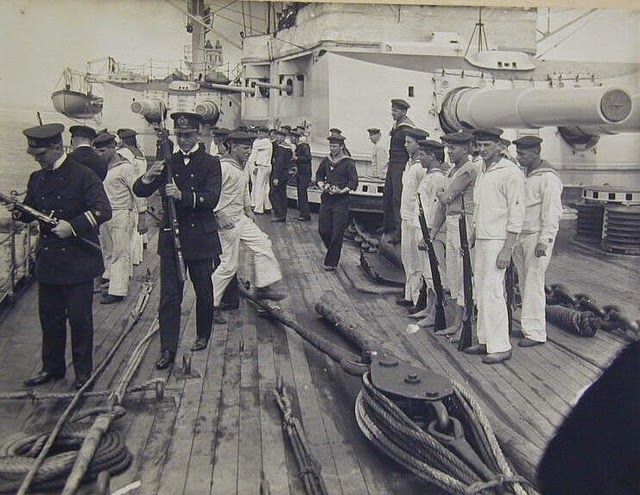
SMS Posen crew on Inspection

Displacement:                  Nassau as built 
normal tons (tonnes)         18,900 (19,200)
full load tons (tonnes)       20,210 (20,530)

Dimension
lenght    (wl)                      477.7 ft (145.6m)
              (oa)                      479.3ft  (146.1m)
beam                                  88.3ft    (26.9m)
draught                              27.9ft     (8.5m)

Armament                                    as built
guns
11 inch (280mm) 45 Cal              12
5.9 inch(150mm)45 Cal               12
3.4 inch(88mm)                           16
torpedo tubes
17.7 inch (450mm)                      6

Armour
side (belt)                                     3.9-11.5 inch (100-300 mm)
armour deck                                 2.2-3.9 inch (55-100 mm)
main turrets                                  3.5-11 inch (90-280 mm)
barbettes                                      11 inch (280 mm)

Machinery
boiler (type)                                Naval
          (number)                           12
engines (type)                             vertical triple expansion
shaft                                            3

Total SHP
designed                                      22,000
trials                                            26,244

Fuel capacity
coal, normal tons (tonnes)          940 (950)
         max tons (tonnes)              2,950 (3,000)

Performance 
designed speed                           19,5 knots
trial speed                                   20 knot
range                                          9,400 miles (7,900 nm) @10 knots
Crew                                          963


 Service career NASSAU
1910-1918  1st Battle squadron, High Seas Fleet
1914 (Aug- May 1916) Sorties with high Seas Fleet
1915 Two stern 3.4 inch (88mm) guns removed
1916 (31 May) Battle of Jutland: Hit by two medium shells, and collided with British destroyer Spitfire during night action
1916 (June-10 July) Repaired
1916 (Aug-April 1918) Three Sorties in North Sea with High Seas Fleet
1916-1917 Remaining 3.4 inch (88mm) guns removed, four 3.4 inch (88mm) anti-aircraft guns mounted
1919 (5 Nov) Stricken
1920 (7 April) transferred to japan and sold for scrap
1924 Scrapped


Ship:           NASSAU                WESTFALLEN          RHEINLAND                POSEN
built:           Wilhelmshaven        Weser,Bremen           Vulcan,Stettin                 Germania,Kiel
                        Dockyard
Authorised: 1907                         1907                           1907                                1907
Laid down:  22 July 1907            12 Aug 1907              1 June 1907                     11 June 1907
Launched:   7 March 1908           1 July 1908                26 Sept 1908                   12 Dec 1908
Completed: Oct 1909                   Nov 1909                   April 1910                       May 1910
Fate:            Scrapped 1924         Scrapped 1924            Scrapped 1922                Scrapped 1921

Rabu, 11 Februari 2015

USS Mississippi

Hello all! Now ijnnavalfleet Blog not just talking about japanese ship but, The other world to! now we start With USS Mississippi.


Mississippi and Idaho were the last of USN's pre-Dreadnoughts,and when laid down and compeleted when fisher's Dreadnoughts,they carried a main battery of heavy,medium and small calibre guns. The Mississippi class were imposed by congress on the US Navy in a vain attempt to combat the rising size and cost of first class battleships. Although they carried a very similiar armament to the preceding Connecticuts, they were inferior in every respect, and were hopelessly outclassed by HMS Dreadnought (which was completed before them). They were therefore sold as soon as possible, and the money used to buy a new dreadnought of the New Mexico.

 Originally, both ships carried a single pole mast forward (known as a military mast) but soon after commissioning they were fitted with a cage or lattice mast aft, and in 1910 the forward mast was replaced by second lattice mast, which balance in design.

 Neither ship saw battle : apart from deployments to the East Coast of North America and to the caribbean, both made cruise to europe. However in June 1912, Mississippi landed US marines in Cuba to protect US interests, and carried men and equipment to Pensacola,Florida , to build a naval air stations. In April and May 1914,she transported seaplanes and crews to Vera Cruz, Mexico ,when American squadron landed a force of 800 marines and seamen during period of political unrest. Mississippi's use as a seaplane tender was probably the first overseas deployment of aircraft by the USN. In 1909 Mississippi and 1911 Idaho entered the Mississippi River for a tour of central US states with no seaboard. In 1910, both ships visited France and Britain, where they must looked old-fashioned.

 In July 1914, Mississippi and Idaho were sold to Greece, becoming the only USN battleship ever to be transferred to a foreign power and rename to Kilkis and Lemnos respectively and served in the Greek navy until April 1941 when they were sunk by German Dive-Bomber Junkers stuka at Salamis thus becoming the first American- built battleship to be lost to air attack.


state of Mississippi Flag
state of Mississippi seal

Service carrier Mississippi
1908:(Sept-Jan 1909) Refit cage mainmast added
1910 (Nov-Jan 1911) Godwill voyage to England and Frances
1911 Refit:bridge modified and cage foremast fitted
1912 (June) carried troops to Cuba
1912( 1 Aug-Jan 1914) In reserve
1914 (6 Jan-3 July) Aircraft depot ship
1914 (4 Apr-June) Vera Cruz incident
1914 (25 Apr) first operational flight by seaborne aircraft
1914 (21 July) sold to Greece, renamed Kilkis
1914 (Aug-1930) Flagship of Greek navy boilers retubed
1932 Relagated to minor duties
1935-1941 Anti-Aircraft training ship
1941 (23 April) Sunk by German Aircraft in Pireus Harbour

Displacement:
Standard tons (tonnes)       12,517 (12,717)
normal tons (tonnes)          12,945 (13,152)
full load tons (tonnes)        14,465 (14,696)

Dimensions:

lenght (wl)                          375ft (114.5M)
           (oa)                          382ft (116.4M)
beam                                   77ft (23.4M)
draught                                24.8ft (7.6M)

Armament:
Guns
12in (305 mm) 45 call         4
8in (203 mm) 45 call           8
7in (178 mm) 45 call           8
3in (76 mm)                         12
3pdr (47 mm)                       4
0.3in (7.6 mm)                     8
21in (533 mm)                     2

Armour:
 Side (belt)                           7-9in (178 -229 mm)
 deck                                     3in    (76mm)
 main turrets                         8-12in (203-305mm)
 barbettes                              10in (254mm)
 secondary turrets                 6-6.5in (152-165mm)
 casemates                            7in (178mm)

Machinery:
 boilers (type)                        Babcock & wilcox
             (number)                   8
 engines (type)                       triple expansion
 shaft                                      2

 Total IHP:
  Designed                              10,000
  Trial (max)                           13,607

 Fuel capacity:
 coal normal tons (tonnes)      600 (610)
         max tons (tonnes)          1,750 (1,778)

 Performance
  Designed speed                      17 Knots
  Trial speed (max)                   17,11 knots
  range                                      8,230 miles (6,920nm) 10 Knots
  crew                                       744-755


                          Ships:            Kilkis (ex-Mississippi BB-23)            Lemnos (ex-Idaho BB-24 )
                         Where built:  Cramp,Philadelphia                              Cramp,Philadelphia
                         Authorised:    1903                                                     1903
                         Laid down:     12 May 1904                                       12 May 1904
                         Launched:       30 September 1905                             9 Dec 1905
                         Completed:    1 Feb 1908                                           March 1908
                         Transferred and renamed: 21 July 1914                     30 July 1914
                         Fate:               Sunk 23 Apr 1941                               Sunk 23 Apr 1941

Senin, 29 Desember 2014

IJN Akashi

 Hello all know i want to talk about another important ship in all fleet. Is Repair Ship in Imperal Japanese Navy Akashi.


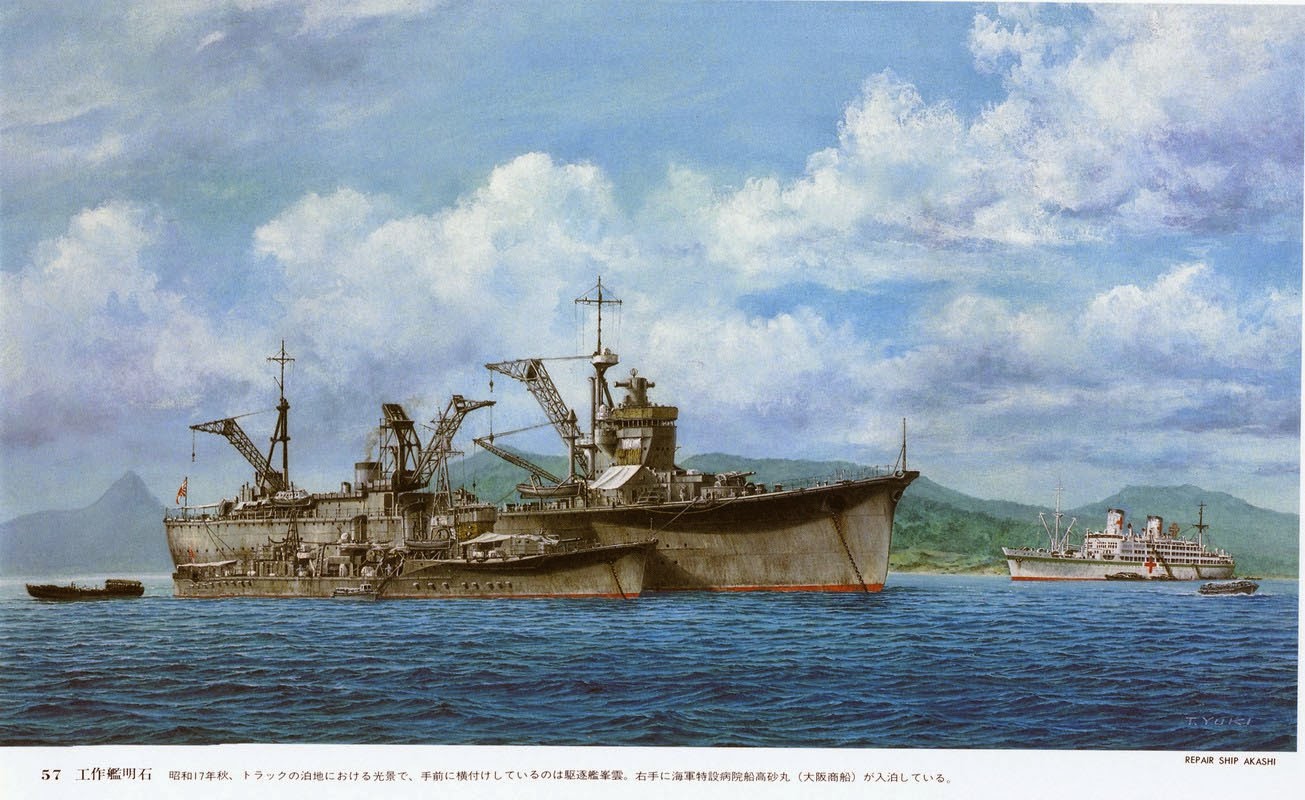
Akashi is the only ship in Japanese Navy designed and built as a construction ship. While the big hitters get all the attention, she's a very important logistic ship.


Before Akashi was constructed, the Japanese Navy modified the captured Russian steam ship Manchuria and operate her as the repair ship Kantou. But this ship sank in an accident in 1924.
Now they wanted a real repair ship.
But, ignoring budget, the (② Plan) was approved in 1934 and finally construction was started in Sasebo Shipyard in January 1937. Construction was finished on July 31st 1937.
Her hull design was a flat-deck type (all the exposed deck from bow to stern was made into a single deck). This gave her more space internally and three large cranes were installed on the deck.
There were 17 workshops in her hull and they worked on everything from milling to finishing. For this, they had 144 units of the latest machine tools imported from Germany that even facilities on the mainland didn't have. Thanks to this, Akashi had a very high repairing capacity.


During the war, Akashi's sister ship Mihara was planned in the "Improved Circle-5 Plan", but because the situation worsed, her construction was halted.


There is this episode of Akashi. In 1940, the crew of Akashi were welcoming the new year on the sea. They wanted to make mochi, but they didn't have a mortar nor a mallet.
So they decided to make that equipment themselves. But instead of a chisel and plane, they used their large sized lathe and as result the wood became soft and easily chipped

Nobody realized this when they were pounding the mochi. Only when the mochi was done did they realize that it was filled with wooden chips.

But because it was a new year celebration, they ate the mochi with tears from their eyes. ( what a tough crew isn it.


Another story is when the submarine i-156 got stranded on Miyakojima. Akashi tried to pull the submarine, but even after moving all the submarine's cargo to Akashi, the submarine still wouldn't budge.

Then, the light cruiser Jintsuu made a circular course at high speed and let the large wave she caused wash over the submarine. Following the timing of the wave, Akashi finally managed to dislodge the submarine.
(from Recollection of Repair Ship Akashi).


Back to the story.
With her equipment, Akashi became the mobile factory of the Combined Fleet and the vital point of the fleet's repair.
While going to Truk, she performed repair on Mogami who had been damaged in the Battle of Midway on the sea. After she arrived, she performed repair on Chitose, Ootaka, Murasame, Chikuma, Teruzuki, Amatsukaze, Sendai, Agano, Akizuki, Kumano, Yakaze and many others. Imagine the long line of patients waiting to meet the doctor.


Of course this was also known to the enemy and there were orders that put her destruction at a higher priority than even Yamato.
She was heavily damaged in an air raid on Truk in February 1944, forcing her to retreat to Palau. Then on March 30th, she hit the bottom after receiving 13 bombs from an air raid on Palau.


After losing Akashi, damaged Japanese ships in the southern front were forced to return to the mainland for repairs. This separated the southern front which had fuel but couldn't do repairs and the mainland which could perform repairs but didn't have enough fuel. Japan had essentially lost it's ability to continue the war.


In modern day, Akashi's name was inherited by JMSDF ocean observation ship (JS Akashi, AGS-5101). Want know more about akashi? See wikipedia of course http://en.m.wikipedia.org/wiki/Japanese_repair_ship_Akashi