Tampilkan postingan dengan label light cruiser. Tampilkan semua postingan

Minggu, 15 Februari 2015

HNMLS De Ruyter

Hello All! Now we gonna talking about my favorite ship De Ruyter! HNLMS mean (maybe) High Netherlands Majesty Ship in English. Now we start now....


 De Ruyter was originally intended to displace only 5,250 tons, with armament of six 5,9 inch (150mm) guns in three twin turrets, one forward and two aft. It was recognised that this was to small for the needs of the East Indies, so the design was enlarged to increase the speed and allow a catapult to be worked in. At same time the opportunity was taken to add a single superfiring 5.9 inch (150mm) gun forward. It would not have been possible to fit a twin turret without enlarging the ship still further. This gave De Ruyter the same broadside as Java and Sumatra, two slightly larger Dutch cruiser laid down in 1916.
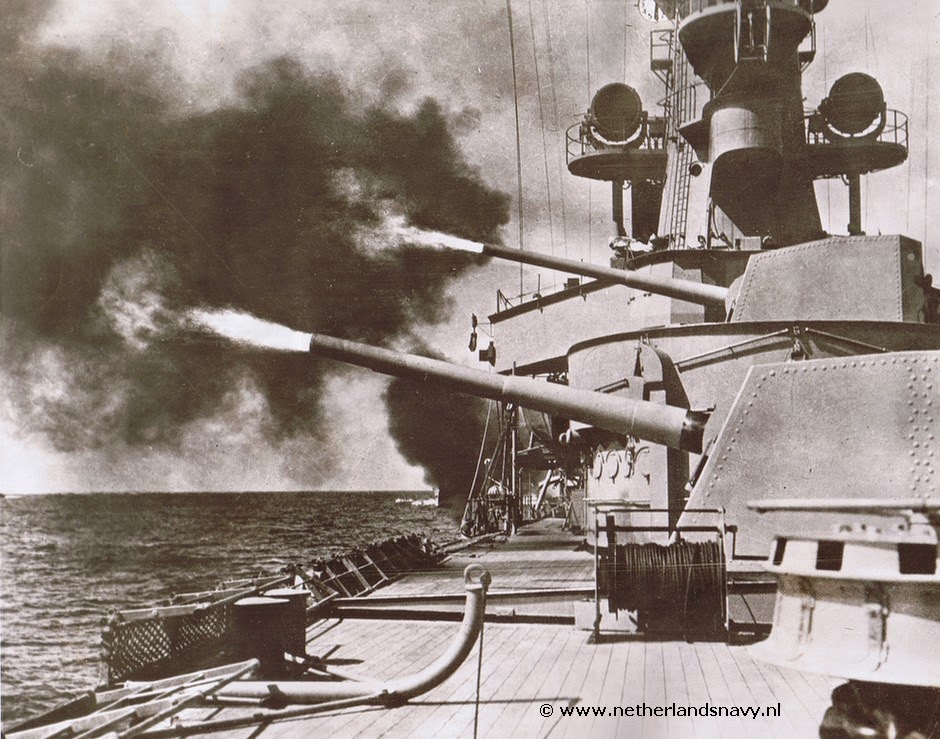
De Ruyter on practice 


 De Ruyter was specifically intended for service in the Dutch East Indies, and habitability was excellent. There was a tower bridge reminiscent of the German Panzerschiff, and smoke deflectors on the funnel gave her an ungainly appearance. Weight was saved by having no torpedoes or heavy anti-aircraft armament, but the 40mm anti-aircraft guns were fitted with advanced power mountings with excellent fire control.
 
  She was hit by one 24in (610mm) type 93 torpedo fired by Japanese cruiser Haguro, and sank two hours later. over 200 of the crew were killed and Admiral Kareel Doorman choose to remain aboard and follow the old tradition of all the ship's captain and sunk with his ship.
Rear-Admiral Karel Doorman


Service Career De Ruyter
1937 (Jan-Mar) To Dutch East Indies
1937(May) Joined East Indies squadron
1940(Jan-Feb) Refit and Repairs to turbines at Surabaya
1941(Dec-Feb 1942) Patrol and convoy escort
1942(27 Feb) Allied Flagship at Battle of the Java Sea
19429(27 Feb) Hit by Japanese torpedo and sunk in two hours

Displacement
Standard tons (tonnes)            6,442 (6,545)
Full load tons (tonnes)            7,548 (7,669)

Dimension
length             (wl)                   552.2ft (168.3m)
                       (oa)                   561ft    (171m)
beam                                        51.5ft   (15.7m)
draught                                    16.4ft   (5m)

Armament
guns
5.9inch (150mm) 50 Cal             7
40mm                                          10
0.5inch (12.7mm))                       8

Armour
side (belt)                                     1.2-2 inch (30-50mm)
deck                                              1.2 inch (30mm)
main turrets                                  1.2 inch (30mm)
barbettes                                       1.2 inch (30mm)

Machinery
boilers (type)                               Yarrow
            (number)                          6
engines (type)                              Parsons single reduction geared turbines
shaft                                             2

Total SHP
designed                                       66,000

Fuel Capacity
oil tons (tonnes)                           1,300 (1,320)

Performance
designed                                       32 knots
range                                            8,100 miles (6,800nm) @ 12 knots
Crew                                            435


Ship:                          De Ruyter
built:                          Wilton-Fijenoord, Schiedam
ordered:                     1 Aug 1932
laid down:                 1 Sept 1933
launched:                  11 May 1935
completed:                3 Oct 1936
fate:                           Sunk 28 Feb 1942

Minggu, 14 Desember 2014

IJN Abukuma

 Hello all sorry for no posting more than 2 months because exam in my school and now i will explaining simple about IJN Abukuma.

Abukuma underway, circa 1941 E13A floatplane on catapult.

IJN Abukuma is built as the 6th ship of the 5,500 tons nagara class light cruiser.great kanto earthquake in 1923 caused many damaged in uraga ship dock,so compared her sister,abukuma's  construction took two years longer. Finally on may 26th 1925 , she's completed and entered service. Her construction period overlapped with the next generation sendai-class light cruiser. During large scales training in 1930 kitakami who moved ahead collided with abukuma from port side, causing massive damaged to abukuma bow during repair , the damaged spoon bow is changed into superior double curved bow design. Among the 5,500 tons class ships , only Abukuma , Jintsuu and Naka is equipped with this kind of bow.in 1938 she is equipped with torpedo launcher tubes and becomethe first among the nagara class to be able shoot oxygen torpedoes.

Become flagships.
At first, she's positioned as the flagships of 1st destroyer squadron. The 1st destroyer squadron mostly consisted older model destroyers.this is because the 1st destroyer squadron tasked to escort the battleship in the back. This contrasted with the 2nd destroyer squadron's newer model destroyer who escort the cruiser fighting in the front line.

 March 27th 1943, Attu island campaign

july 29th 1943, she became flagship of the kiska island evacuation operations. Abukuma collided with coast guard's ship kunashiro, but she still managed to finished the mission.
by the way, during this mission Abukuma mistakenly identify an island as enemy ship and proceed to launch torpedo together with destroyer Shimakaze and scored perfect hits on their target. In total they wasted around 200,000 yen worth of torpedoes.in today's currency, that's about 1 billion yen.

Battle of surigao strait
October 25th 1944, she joined vice admiral shima's fleet in battle of Surigao strait who will entered the battle from behind Nishimura fleet. But she hit by torpedo and have emergency repair in mindanao island.
 After the repair, accompanied by ushio, she headed to coron. On the way  they're attacked by 30 B-24 Bombers. After receiving 3 hits and 4 near misses Abukuma is stopped. Her torpedo tubes explode and an order to abandon ships is issued. With her bow standing, Abukuma sank in to the phillipine's  Negron island's water. Ushio rescued her survivor and send the to manila. In present day , the second escort "Abukuma" served as escort ship in the JMSDF. Her sisters in the abukuma class escort ship are Jintsuu, Sendai, chikuma and tone. Glad to see their names are still perpetuated by the japanese for their new vessel to honor the spirits of the crew who has sacrificed for the country.
Abukuma now


Sorry all for my shortcomings because i use the tab to works on this blog, because my laptop screen broke and cannot be used anymore.

Want to know anymore about Ijn Abukuma? You can oped wikipedia


Senin, 20 Oktober 2014

IJN Mogami


These ships win the prize for "Egregious Treaty Violation." The London Naval Treaty of 1930 (a follow-on to the Washington Naval Treaty of 1922) specified that cruisers of all signatory nations were to be held to displacements of 10,000 tons. Mogami, when first built, weighed in at about 13,400 (although I should also mention that some other Japanese CAs had been rebuilt by that point to exceed even this displacement). Not surprisingly, foreign naval observers were a little suspicious about her. Turns out that even given her extra displacement, she was overloaded. When she began running trials, it was discovered that firing all the guns of her main battery simultaneously had the unpleasant effect of popping the welds along her sides. Hmmm... When first launched, these ships were officially classified as light cruisers, because they were armed with 15 x 6" guns. They had been cleverly designed so that the turret base rings would also accept a dual 8" turret when the time came, and all were re-armed this way shortly before the war. Very sneaky...
At the battle of Midway, Mogami was very nearly sunk, and it was decided to rebuild her as an a hybrid cruiser/carrier to carry additional float planes. As you probably gathered from my comments on Ise and Hyuga, I'm not very impressed with this move, because none of these hybrid ships were very useful as aviation vessels. I find it ironic that Mogami's last action was to be sunk at the hands of the same U.S. battleships that sank Fuso andYamashiro in Surigao Strait. Apparently, she was useless enough as an aviation vessel that she wasn't even included in Ozawa's sacrificial carrier bait force, but was relegated to surface combat duty with the two oldest BBs in the Japanese Navy.

The Mogami-class (最上型?) were a class of four warships built initially for theImperial Japanese Navy (IJN) as light cruisers in the early 1930s under the weight and armament restrictions of theLondon Naval Treaty. After Japan refused to comply any longer with that agreement, all four ships were rearmed with larger caliber main armament and were reclassified as heavy cruisers. All four fought in World War II, and were sunk.
The Mogamis have been seen by naval architects as a design failure. The IJN's Naval staff insisted that each new class be superior to anything else in its category, yet designers strove to stay in compliance with treaty regulations. As a result, the initial construction of these ships was overly light; within their first few years of service, all four had to be reconstructed to remain seaworthy. They were also unstable seaboats due to excessive topweight and their welded seams cracked under the stress of firing their own main guns.
IJN Mikuma, 1939
Class overview
Operators: Imperial Japanese Navy
Preceded by:Takao-class cruiser
Succeeded by:Tone-class cruiser
Built:1931–1937
In commission:1935–1944
Completed:4
Lost:4
General characteristics
Type:Heavy cruiser
Displacement:8,500 tons (standard load) 10,980 tons (full load)
Length:201.6 m (661 ft 5 in)
Beam:20.6 m (67 ft 7 in) (Mogami-class)
20.2 m (66 ft 3 in) (Suzuya-class)
Draft:5.5 m (18 ft 1 in)
Propulsion:Four-shaft impulse single geared turbines
10 Kampon boilers (Mogami-class)
8 Kampon boilers (Suzuya-class)
152,000 shp
Speed:37 knots (43 mph; 69 km/h)
Range:8,000 nmi (15,000 km) at 14 kn (16 mph; 26 km/h)
Complement:850
Armament:
(initial)
• 15 × 155 mm/60-cal guns (5×3) (replaced by 10 x 20 cm/50 3rd Year Type 2 guns (5x2) from 1939)
• 8 × 127 mm (5.0 in)/40-cal DP guns (4×2)
• 4 × 40 mm AA guns
• 12 × 610 mm (24 in) torpedo tubes(4×3)
Armor:Belt: 100 mm (3.9 in)
Deck: 35 mm (1.4 in)
Turrets: 25 mm (0.98 in)
Magazines: 127 mm (5.0 in)
Aircraft carried:3 × Aichi E16A reconnaissancefloatplanes

Design[edit]

For the 1931 Fleet Replenishment Program, believing themselves understrength in cruisers, the IJN chose to build to the maximum allowed by theWashington Naval Treaty. This resulted in the choice of 155 mm (6.1 in) guns in five triple turrets (a first for Japan) in theMogamis, also capable of 55° elevation, making the Mogamis one of the very few classes of cruiser to have a dual purpose (DP) main battery; this was coupled with very heavy anti-aircraft protection, as well as the standard reloadable, turreted torpedo tubes, also unique to the IJN.[1]
To save weight and improve transverse stability, the class was given a more compact and lower superstructure, electric welding was used, as was aluminium in the superstructure.[2]Aiming to meet the weight limits compelled them to fit only ten boilers (compared to twelve in the previous Takao and Myoko classes), trunked into a single funnel stack (which also savedtophamper). The new impulse geared turbines added 22,000 shp over Atago, increasing the top speed by 1.5 knots (2.8 km/h). Protection, however, was not stinted on; the class proved able to take substantial punishment.
The declared weight was 8,500 tons, though the true design weight was 9,500 and at trials they would displace 11,169 tons.[3]
The designers, however, had overreached; excessive topweight led to instability, and gunnery trials revealed cracking hull welds. Hull bulges were retrofitted to Mogami and Mikuma, and added to Kumano and Suzuya, increasing beam to 20.5 m (67 ft) and displacement to 11,200 tons, cutting speed by 2 kt (3.7 km/h).[4]
Following Japan's withdrawal from the Second London Naval Treaty, plans were made to modernize and expand the entire fleet. Beginning in 1939, the class was brought in for substantial reconstruction, replacing the triple 155 mm turrets with twin 203 mm (8-inch) guns, turning over the 155 mm turrets for the battleship Yamato.[5] Indeed, the designers had designed the class in mind so that the 6-inch guns could be switched with 8-inch batteries, in effect making them heavy cruisers and skirting the London Naval Treaty, though the Japanese had withdrawn from the conference and were not signatories to the Second London Naval Treaty of 1936.
Torpedo bulges were also added; in all, displacement rose to over 13,000 tons, and speed dropped to 34.5 kt (63.8 km/h).
The United States Navy's Brooklyn-class cruisers were designed specifically to counter theMogami-class, and as a result had a very similar armament to the pre-refit Mogamis, in a nearly identical layout, though the US-pattern 6"/47 weapon was semi-automatic, with a higher rate of fire and the three weapons in each turret mounted in a single sleeve. Japan's choice of the 155mm gun caliber is curious, as Japan already had a 6" (152mm) weapon in service, of nearly equal performance. In spite of the resulting multiplicity of similar gun calibers, Japan resented the 5-5-3 treaty ratios, and had vowed to build to the very limit allowed by the 1922 Washington and 1930 London Naval Treaties. As the French had already used a 155mm main battery in the three Duguay-Trouin-class cruisers (1922–1926), this became the largest gun caliber allowed for light cruisers under the 1930 London Naval Treaty.

War service[edit]

All four ships participated in the Japanese invasion of the Dutch East Indies. The Mogami andMikuma were present at the Battle of Sunda Strait and contributed to the sinkings of HMASPerth and USS Houston.
In June 1942, all four took part in the Battle of Midway, where Mogami and Mikuma collided trying to avoid a submarine attack; Mikuma was finished off on 6 June 1942 by aircraft fromUSS Enterprise and Hornet. The heavily damaged Mogami limped home and spent ten months in yard, during which her afterparts were completely rebuilt, and "X" and "Y" turrets were replaced by a flight deck (with the intention to operate 11 aircraft).
In October 1944, the survivors were reunited at the Battle of Leyte GulfMogami, heavily damaged by a collision with Nachi, cruiser gunfire, and aerial attack was scuttled by Akebono, while Kumano stumbled into Manila harbor on one boiler, to be put out of her misery byHalsey's aviators on 25 November 1944; the US escort carrier planes mauled Suzuya at Leyte, and she was scuttled by Okinami on 25 October.

Criticism[edit]

This class is seen by naval architects as trying to fit a quart into a pint pot. The IJN's Naval staff insisted that each new class be superior to anything else in its category, this placed an enormous burden on Japanese naval constructors and the difficulties with these ships have to be seen in this light.
The initial construction was extremely light in order to comply with the naval treaties and had to be remedied. When the Royal Navy's Director of Naval Construction (DNC) was told about these ships, by British Naval Intelligence quoting the public displacement figure, he replied that the capabilities quoted could not be achieved on this displacement and that "they must be building their ships out of cardboard or lying".
Though the placement of Turret #3 improved its firing arc, and though the class had the stability problems fixed (the preceding Takao-class cruisers were considered too top-heavy), the Mogamis are generally not considered an improvement over the Takaos.[6] Nonetheless, the follow-up Tone-class retained many aspects of the Mogami-class design. However, theTones were intended for a different purpose with all of their main armament forward, so their stern could accommodate extra floatplanes.

Ships[edit]

Sub classNameBuilderLaidLaunchedCompletedFate
MogamiMogami(最上)Kure Naval Arsenal27 October 193114 March 193428 July 1935Sunk during the Battle of Leyte Gulf on 25 October 1944
Mikuma(三隈)Mitsubishi Nagasaki Shipyard24 December 193131 May 193429 August 1935Sunk during the Battle of Midway on 5 June 1942
SuzuyaSuzuya(鈴谷)Yokosuka Naval Arsenal11 December 193320 November 193431 October 1937Sunk during the Battle off Samar on 25 October 1944
Kumano(熊野)Kōbe-Kawasaki Shipbuilding Yard5 April 193415 October 193631 October 1937Sunk during thePhilippine campaign on 25 November 1944 by aircraft of USSTiconderoga
IJN mogami in game forgotten hope
IJN Mogami, Yamashiro in Battle of the Surigao strait 1944.

main linkhere

another link another

Minggu, 19 Oktober 2014

IJN Yubari


Yūbari (夕張?) was an experimental light cruiser built between 1922 and 1923 for the Imperial Japanese Navy (IJN). Although a test bed for various new designs and technologies, she was commissioned as a front-line warship and participated in numerous combat operations during World War II before she was sunk by the U.S. Navy. Designs pioneered on Yūbari had a major impact on future Japanese warship designs.This ship represents the begining of all 'modern' Japanese cruiser design. She was originally laid down as an experimental cruiser under the guidance of Yuzuru Hiraga, the most famous Japanese naval architect of his time. Yubari presented quite a radical appearance with her combined, swept-back main funnel and clipper bow. She served as a prototype for the forthcoming Furutaka, which incorporated many of Hiraga's ideas concerning weight reduction and cramming the maximum firepower into a given displacement.
Yubari n09957.jpg
"Yūbari" in 1924
CareerNaval Ensign of Japan.svgJapanese Navy Ensign
Name:Yūbari (夕張)
Namesake:Yūbari River
Ordered:October 1921
Builder:Sasebo Naval Arsenal
Laid down:5 June 1922
Launched:5 March 1923
Commissioned:23 July 1923
Fate:sunk 28 April 1944 by US submarine Bluegill
General characteristics
Class & type:light cruiser
Displacement:2,890 t (2,840 long tons) standard (designed); 3,141 t (3,091 long tons) full load (designed); 4,075 t (4,011 long tons) full load (actual)
Length:138.90 m (455 ft 9 in)
Beam:12.04 m (39 ft 6 in)
Draft:3.58 m (11 ft 9 in)
Installed power:43,060 kW (57,740 hp)
Propulsion:3 × geared steam turbines
8 × Kanpon boilers
3 × shafts
Speed:35.5 kn (65.7 km/h; 40.9 mph)
Range:5,000 nmi (9,300 km; 5,800 mi) at 14 kn (26 km/h; 16 mph)
Complement:328
Armament:6 × 14 cm/50 3rd Year Type naval guns (2x2, 2x1)
1 × 8 cm/40 3rd Year Type naval gun
2 × machine guns
Type 91 torpedoes (2x2)
34 × mines
Armor:
  • Belt: 38 mm (1.5 in)
  • Deck: 25 mm (0.98 in)
  • Turrets: 25 mm (0.98 in)

Background[edit]

Construction of an experimental light cruiser was authorized under the 1917 8-4 Fleet Program but funding was not available until 1921.[2] By that time, due to restrictions imposed by the Washington Naval Treaty, the Imperial Japanese Navy was forced to adopt a limit in the total displacement of its fleet to 300,000 tons. Yūbari was designed as an experimental scout cruiser that would have the combat potential of the standard 5,000 t (4,900 long tonsSendai class cruiser but with a much lighter displacement. Captain Yuzuru Hiraga, Japan’s leading naval architect, assisted by Lieutenant Commander Fujimoto Kikuo, developed an innovative design which strongly influenced the design of Japan’s subsequent heavy cruisers, as well as destroyers.[2]

Design[edit]

World War II recognition drawings of Yubari
The basic design premise of Yūbariwas that the highest possible speed and weaponry be maintained with the greatest possible weight reduction.[2]To save weight, the armor was integrated directly into the hull structure, forming the side walls and deck. Yūbari had 38mm of belt armor protecting the machinery spaces and gun magazines, and 28mm armor for the deck and bridge, giving the vessel far superior armor than the previous 5000-ton cruiser designs. Theforecastle was given significant flare to improve seakeeping.
Propulsion was similar to that of a destroyer, with eight oil-fired Kampon boilers feeding three turbine engines, generating 43,060 kW (57,740 hp).[2] However, the exhaust was trunked into a single centrally-located smokestack, reducing the overall length of the design and freeing deck space.
The main battery consisted of six 14 cm/50 3rd Year Type naval guns mounted in two twin gun turrets and two single gun turrets located on the centre line of the ship’s axis in an arrangement which allowed one single and one twin turret to fire over the bow or stern. A single 8 cm/40 3rd Year Type naval gun and two 7.7mm machine guns were located amidships on a raised platform for anti-aircraft defense. Two twin-mount torpedo launchers were also on the centerline of the ship’s axis, one on either side of the anti-aircraft gun platform, with four loaded and four reserve Type 91 torpedoes. The fire control system was centralized into an enlarged bridge.[2]
The ship was completed 419 t (412 long tons) (13%) over the designed displacement, resulting in an extra foot of draft and a loss of 1.5 kn (2.8 km/h; 1.7 mph) in designed speed.[3] The use of new technologies and unproven designs led to a number of issues which only became apparant once Yūbari was commissioned. The smoke stack was found to draw poorly, and was enlarged by 1.80 meters in 1924. Additional ballast was also added to increase stability. In 1932, the 80mm anti-aircraft gun was removed and in 1935, two twin Type 93 13mm guns were fitted. These were replaced by two twin 25mm guns in 1940.[2]
Yūbari had a significant refit in early 1944 when the two single 140 mm (5.5 in) main guns were removed and replaced by one Type 10 120 mm (4.7 in) gun (in the "A" position) and six twin and one triple Type 96 25-mm AA guns together with a Type 22 search radar and two depth charge launchers.[4]

Service history[edit]

Yūbari was laid down on 5 June 1922, launched on 5 March 1923 and completed at Sasebo Naval Arsenal, and commissioned on 23 July 1923.[5]
Completed just prior to the 1923 Great Kanto EarthquakeYūbari was quickly pressed into service to help evacuate refugees from Yokohama and other stricken areas. During this time (10 September 1923), Crown Prince Hirohito also visited the vessel while at Yokosuka. In April 1925, Yūbari shadowed maneuvers of the United States Navy off of Oahu. American destroyers gave chase, but Yūbari was able to outrun them. She was reassigned to the reserves in November 1933
In November 1934, Captain Tadashige Daigo assumed command, and Yūbari was reassigned to the Yokosuka Naval District, where she was modernized and refitted in November 1935. Afterwards, she was assigned to patrols off of the China coast. With the start of the Second Sino-Japanese War in August 1937, Yūbari assisted in the evacuation of Japanese civilians from coastal cities in southern China. Subsequently, she was sent north to cover landings by the Imperial Japanese Army at Hangzhou on 20 October. She returned to Yokosuka and was reassigned to the reserves in December of the same year. She was sent from March through October 1939 to the Ōminato Guard District to patrol the coast of Sakhalin  At the time of the attack on Pearl HarborYūbari was flagship of Destroyer Squadron Six of the IJN 4th Fleet, tasked with the defense of the South Pacific Mandate, and was based out of Truk from late 1941 through 1942.
Early in the war, Yūbari was the flagship for the Japanese invasion force during the invasion of Wake Island. She led both invasion attempts on 11 and 23 December 1941.[8] During shore bombardment operations, she was bracketed by gunfire from the USMC defenders, but took no damage
Subsequently, Yūbari and her destroyers participated in the capture of Rabaul and New Ireland in the Soloman Islands, followed by the Invasion of Salamaua–Lae on 8 March 1942. On 10 March, she was attacked by two Douglas SBD-3 Dauntless dive bombers from USS Lexington (CV-2), who score severe near-misses which killed a number of the anti-aircraft gun crews. She was then strafed by four Grumman F4F-3 Wildcat fighters from Lexington, which killed her executive officerand several crewmen on her bridge. The following morning, she was again attacked, with Yorktown’s SBD-3s managing to detonate gunpowder bags near her No.2 turret, causing a fire which sets the protective mattresses around the bridge on fire. The F4F-3 strafing run detonated gasoline drums stored on her port lifeboat. Firefighting teams realize to their dismay that due to a design error, the fire hoses were too short, and the fire threatened the forward torpedo mount. The captain ordered the torpedoes jettisoned, but the mount would not rotate due to a power failure, forcing the crew to use pulleys and ropes and to dump the torpedoes manually. During this battle, Yūbari evaded 67 bombs and 12 torpedoes, suffering 13 killed and 49 wounded. Returned to Rabaul, she was then bombed on 10 March by four USAAF B-17 Flying Fortressbombers, with four near-misses opening three large holes in her stern. She returned to Truk for repairs on 25 March.
Yūbari was next assigned as the flagship of the Port Moresby Attack Force during Operation MO on 4 May. She was again attacked by four B-17 bombers on 7 May, but without damage. The same day, she managed to rescue a number of survivors from the Shōhō , which had been sunk earlier[6] She returning to Truk on 13 May when the operation was cancelled following the Battle of the Coral Sea.[9] She returned to Yokosuka for refit from 19 May to 19 June[6]
Beginning 29 June 1942, Yūbari took part in the Solomon Islands Campaign, including landing personnel on Guadalcanal to construct an airfield. From 17 June, she started to develop problems with her engines, and was limited to 26 knots on two shafts. Yūbari participated in the Battle of Savo Island on 9 August.[10][11] She scored several hits on the American destroyerUSS Ralph Talbot (DD-390), and one of the torpedoes that sank the heavy cruiser USS Vincennes has been attributed to her.
From 20 August, Yūbari was based out of Truk, making patrols between Truk and the Marshall islandsGilbert Islands, and Palau. She was based at Tarawa from 20 October to 20 November as a guard ship.[6] She returned to Yokosuka at the end of December, where her middle turbine was repaired and additional anti-aircraft weaponry was installed in February 1943. She returned to Rabaul on 1 April and was assigned to the Southwest Area Fleet. On 2 July, Yūbari and her destroyers bombarded the American beachhead established at Rendova Island, but with little effect. On her return to BuinYūbaristruck a naval mine, damaging her bow and wounding 26 crewmen. The damage also limited her speed to 22 knots and forced a return to Yokosuka for repairs from August through October. In addition to repairs, additional anti-aircraft guns, a Type 22 surface search radar and Type 94 sonar were installed. She returned to Rabaul on 3 November. On 4 November, she rescued 196 troops and three artillery pieces from the transport Kiyosumi Maru, which had been damaged by a bombing attack the previous day. On 6 November, she undertook a "Tokyo Express" transport run with 700 troops from theIJA 17th Division and 25 tons of supplies to Bougainville IslandYūbari was damaged slightly by a strafing attack in the 11 November Carrier Raid on Rabaul, and again on 14 November. On 18 November, she attempted another troop transport run to Garove Island in New Britain, but the mission was cancelled after Yūbari was damaged in an attack by USAAF B-24 Liberators and USN PBY Catalinas. She returned to Yokosuka on 19 December for repairs and the installation of yet more anti-aircraft guns. She returned to Saipan on 30 March 1945, and Palau on 25 April[
Yūbari was sighted on 27 April 1944 off Palau by the USN submarine Bluegill on her first war patrol.[12] Bluegill fired six torpedoes, of which Yūbari managed to evade four, but two hit on her starboard side near her Number 1 boiler room. Soon afterwards, her Number 2 boiler room was also flooded. She attempted to get underway using only her middle shaft, but the attempt failed, as did an attempt by the accompanying destroyer Samidare to take her in tow. Yūbari sank almost 24 hours after being torpedoed, at position 05°20′N 132°16′E, with the loss of 19 crewmen. She was officially removed from the navy list on 10 June 1944.
IJN yubari in Far left
Yubari off Shanghai, China, Apr 1937

main linkhere


another linkhttp://www.combinedfleet.com/ships/yubari