Kongō underwent two major reconstructions. Beginning in 1929, the Imperial Japanese Navy rebuilt her as a
battleship, strengthening her armor and improving her speed and power capabilities. In 1935, her superstructure was completely rebuilt, her speed was increased, and she was equipped with
launch catapults for
floatplanes. Now fast enough to accompany Japan's growing carrier fleet,
Kongō was reclassified as a
fast battleship. During the
Second Sino-Japanese War,
Kongō operated off the coast of mainland China before being redeployed to the Third Battleship Division in 1941. On the eve of World War II, she sailed as part of the Southern Force in preparation for the
Battle of Singapore.

Kongō in her 1944 configuration
|
| Career (Empire of Japan) |  |
|---|
| Name: | Kongō |
| Namesake: | Mount Kongō |
| Ordered: | 1911 |
| Builder: | Vickers Shipbuilding Company,Barrow-in-Furness |
| Laid down: | 17 January 1911 |
| Launched: | 18 May 1912 |
| Commissioned: | 16 August 1913 |
| Struck: | 20 January 1945 |
| Fate: | Sunk by USS Sealion in the Formosa Strait, 21 November 1944 |
| General characteristics |
|---|
| Class & type: | Kongō-class battlecruiser |
| Displacement: | 36,600 long tons (37,187 t)[1] |
| Length: | 222 m (728 ft 4 in)[1] |
| Beam: | 31 m (101 ft 8 in)[1] |
| Draught: | 9.7 m (31 ft 10 in)[1] |
| Propulsion: | Steam turbines, 4 shafts |
| Speed: | 30 knots (35 mph; 56 km/h)[1] |
| Range: | 10,000 nmi (19,000 km) at 14 kn (26 km/h)[1] |
| Complement: | 1360 |
| Armament: |
1913:
1944:
|
| Armor: |
- Decks: 2.3–1.5 in (58–38 mm) (later strengthened +101 mm on ammo storage, +76 mm on engine room)
- Turrets: 9 in (230 mm)
- Barbettes: 10 in (250 mm)
- Belt: 8–11 in (200–280 mm)
|
Design and construction[edit]
The
Kongō was the first of the
Imperial Japanese Navy's
Kongō-class
battlecruisers, which were almost as large, costly and well-armed as
battleships, but which traded off armored protection for higher speeds. These were designed by the British naval
engineer George Thurston and were ordered in 1910 in the Japanese Emergency Naval Expansion Bill after the commissioning of
HMS Invincible in 1908. These four battlecruisers of the
Kongō class were designed to match the naval capabilities of the battlecruisers of the other major naval powers at the time, and they have been called the battlecruiser versions of the British (formerly
Turkish) battleship
HMS Erin. Their heavy armament of 14-inch naval guns and their armor protection (which took up about 23.3% of their approximately 30,000-ton displacements in 1913) were greatly superior to those of any other Japanese
capital shipafloat at the time.
The
keel of the
Kongō was laid down at
Barrow-in-Furness by
Vickers Shipbuilding and Engineering on 17 January 1911. Under Japan's contract with Vickers, the first vessel of the class was constructed in the
United Kingdom, with the remainder built in Japan.The
Kongōwas launched on 18 May 1912, and then transferred to the dockyards of
Portsmouth, England, where her
fitting-out began in mid-1912.All parts used in her construction were manufactured in the U.K. The
Kongo was completed on 16 April 1913.after Kongo warships to Japan only with the protection of steel that thin would not accept Japanese but with a thickness of thin steel with offset at a rapid pace is the hallmark of the era British warship dreadnought.dengan gave an extra layer of steel ships were originally Kongo around 29 knots down to 25 knots
Armament[edit]
The
Kongō's main battery consisted of eight 14-inch (36 cm) heavy-caliber main
naval gunsin four twin
turrets (two forward and two aft).The turrets were noted by the U.S. Office of Naval Intelligence to be "similar to the British 15-inch turrets", with improvements made in
flash-tightness. Each of her main guns could fire
high explosive or
armor-piercing shells 38,770 yards (19.14 nmi; 35.45 km) at a firing rate of about two shells per minute. In keeping with the Japanese doctrine of deploying more powerful vessels before their opponents, the
Kongō and her sister ships were the first vessels in the world equipped with 14-inch (36 cm) guns. Her main guns carried ammunition for 90 shots, and they had an approximate barrel lifetime of 250 to 280 shots. In 1941, separate dyes were introduced for the armor-piercing shells of the four
Kongō-class battleships to assist with targeting, with the
Kongō's armor-piercing shells using red dye.
The
secondary battery of the
Kongō originally consisted of sixteen 6-inch (15 cm) 50-
caliberguns in single
casemates (all located amidships), eight 3-inch (7.6 cm) guns, and eight submerged 21-inch (53 cm) torpedo tubes. ("50 calibre" means that the lengths of the guns were to times their bore, or 700 inches.) Her six-inch naval guns could fire five to six rounds per minute, with a barrel lifetime of about 500 rounds. The 6-inch/50 calibre gun was capable of firing both antiaircraft and antiship shells, though the positioning of these guns on the
Kongō made antiaircraft firing mostly impractical. During her second reconstruction, the older three-inch guns were removed and then replaced with eight 5-inch (13 cm) 5-inch/40 calibre dual-purpose guns. These guns could fire from eight to 14 rounds per minute, with a barrel lifetime of about 800 to 1,500 rounds. Of
Kongō's guns, the 5-inch guns had the widest variety of
shell types: antiaircraft, antiship, and illumination shells. The
Kongō was also armed with a large number of 1-inch (2.5 cm) antiaircraft machine guns. By October 1944, the
Kongō's secondary armament was reconfigured to eight 6-inch (15 cm) guns, eight 5-inch (13 cm) guns, and 122
Type 96 antiaircraft
rapid-fire cannons.
Her Service in the I.J.N.[edit]
1913–1929: Battlecruiser[edit]

The
Kongō in her battlecruiser configuration, pre-1927.
On 16 August 1913, the
Kongō was completed and commissioned into the Imperial Japanese Navy (I.J.N.). Twelve days later, she departed from Portsmouth headed for Japan. She was docked at
Singaporefrom 20 October to the 27th, before arriving at
Yokosuka Naval Arsenal on 5 November, where she was placed in First Reserve.
] In January 1914, she docked at
Kure Naval Base for armament checks. On 3 August 1914, the
German Empire declared war on
France and then invaded via
Belgium, sparking the beginning of
World War I in the West. Twelve days later, Japan issued a warning to
Kaiser Wilhelm II of the
German Empire, ordering him to withdraw the German troops from their base at
Tsingtao,
China. When the German Empire did not respond, Japan declared war on the Germany on 23 August, occupying the former German possessions in the
Caroline Islands,
Palau Islands,
Marshall Islands, and
Marianas Islands.
[6] The
Kongō was quickly deployed towards the
Central Pacificto patrol the sea lines of communication of the German Empire. The
Kongō returned to the port of
Yokosuka, Japan, on 12 September, and one month later, she was assigned to the First Battleship Division. In October, the
Kongō and her new sister ship
Hiei sortied off the Chinese coast in support of Japanese army units during the
Siege of Tsingtao. Then the
Kongō returned to
Sasebo Naval Base for upgrades to her searchlights. On 3 October 1915, the
Kongō and the
Hiei participated in the sinking of the old
Imperator Nikolai I as a practice target. She was a Russian pre-
dreadnought that had been captured in 1905 during the
Russo-Japanese War that had next served as an I.J.N.
warship. With the defeat of the
German East Asia Squadron by the
Royal Navy at the
Battle of the Falkland Islands in December 1914, there was little or no need for I.J.N. operations in the
Pacific Ocean. The
Kongō spent the rest of World War I either based at Sasebo, or on patrol off the coast of China. In December 1918, following the end of the hostilities of World War I, the
Kongō was placed in "Second Reserve". In April 1919, she was fitted with a new seawater flooding system for her ammunition magazines.
With the conclusion of World War I, and the signing of the
Washington Naval Treaty on 6 February 1922, the size of the I.J.N. was significantly limited, with a ratio of 5:5:3 required between the capital ships of the
United Kingdom, the
United States, and the Japanese Empire, since the latter was only responsible for one ocean, rather than the two of the other country, and fewer warships for France and
Italy.
[16] This Treaty also banned the signatories from building any new capital ships until 1931, with no capital ship permitted to exceed 35,000 long tons (36,000 t) in
displacement. Provided that new additions did not exceed 3,000 tons of displacement, the existing capital ships were allowed to be upgraded with improved
anti-torpedo bulges and
armored main decks. By the time that the Washington Naval Treaty had been fully implemented in Japan, only three classes of World War I type capital ships remained active: the
Ise-class battleships, the
Kongō-class battlecruisers, and the
Fusō-class battleships.
In April 1923,
Kongō gave
transportation to
Emperor Hirohito during his official visit to the Japanese possession of Formosa (now
Taiwan) off the coast of China. In November 1924, the
Kongo docked at Yokosuka, where modifications were made to her main armament, increasing the elevation of her main guns and improving her fire-control systems. In 1927, the
Kongō underwent major modifications to her superstructure, rebuilding it into the
pagoda mast style to accommodate the growing number of fire-control systems for her main guns.
]In May 1928, her steering equipment was upgraded, before she was placed in reserve in preparation for major modifications and reconstruction in 1929–31.
1929–1935: Reconstruction into battleship[edit]

Kongō in 1931, following her first reconstruction
Prohibited by the Washington Treaty from constructing new capital ships until 1931, Japan resorted to upgrading their World War I era battleships and battlecruisers. Beginning in September 1929, the
Kongō underwent extensive modernization and modification in drydock at Yokosuka Naval Arsenal.
[7] Over the next two years, the
Kongō's horizontal armor near her ammunition magazines was strengthened, and the machinery spaces within the hull were given increased torpedo protection. Anti-torpedo bulges were added along the waterline, as permitted by the Washington Treaty.
]She was refitted to accommodate three Type 90 Model 0 floatplanes, though no
aircraft catapults were fitted.To increase her speed and power, all 36 of her Yarrow boilers were removed, and then replaced with 16 newer boilers, and Brown-Curtis direct-drive turbines were installed. The
Kongō's forward funnel was removed, and her second funnel was enlarged and lengthened. The modifications to her hull increased her armor weight from 6,502 to 10,313
long tons, directly violating the terms of the Washington Naval Treaty. In March 1931, the
Kongō—now capable of a speed of 29 knots (54 km/h)—was reclassified as a battleship.
On 22 April 1930, Japan signed the
London Naval Treaty, placing further restrictions on the signatories' naval forces. Several of her older battleships were scrapped, and no new capital ships were built as replacements.
[20] After minor fitting-out work, the
Kongō's reconstruction begun in September 1929 and was declared complete on 31 March 1931. On 1 December 1931, two months after the
Japanese invasion of Manchuria, the
Kongō was assigned to the First Battleship Division and also designated the flagship of the Combined Fleet. Additional rangefinders and searchlights were fitted to her superstructure in January 1932, and Captain
Nobutake Kondō assumed command of the vessel in December. In 1933, aircraft catapults were fitted between the two rear turrets.
On 25 February 1933, following a report by the
Lytton Commission, the
League of Nationsagreed that Japan's invasion of China had violated Chinese sovereignty.Refusing to accept the judgement of this organization, Japan withdrew from the League of Nations on the same day. Japan also immediately withdrew from the Washington Naval Treaty and the
London Naval Treaty, thus removing all restrictions on the numbers and sizes of her capital warships. In November 1934, the
Kongō was placed in Second Reserve in preparation for further modifications. On 10 January 1935, the
Kongō was toured by the
Nazi German naval attaché to Japan, Captain
Paul Wenneker, as part of a gunnery demonstration.
[6]
1935–1941: Fast battleship[edit]
On 1 June 1935, the
Kongō was dry-docked at Yokosuka Naval Arsenal in preparation for upgrades that would enable her to escort Japan's growing fleet of
aircraft carriers. Her stern was lengthened by 26 feet (7.9 m) to improve her
fineness ratio and her 16 older boilers were removed and then replaced with 11 oil-fired Kampon Boilers and newer geared turbines. In addition, her bridge was completely reconstructed according to Japan's
pagoda mast style of forward superstructure, and
catapults were added to support three
Nakajima E8N or
Kawanishi E7K reconnaissance and spotter floatplanes.
The
Kongō's armor was also extensively upgraded. Her main belt was strengthened to a uniform thickness of eight inches (up from varying thicknesses of six to eight inches), and also diagonal bulkheads of depths ranging from 5 to 8 inches (127 to 203 mm) were added to reinforce the main armored belt. The turret armor was strengthened to 10 inches (254 mm), while 4 inches (102 mm) were added to portions of the deck armor.
[ The
Kongō's ammunition magazine protection was also strengthened to 4.0 inches (10 cm). This reconstruction was finished on 8 January 1937. Capable of greater than 30 knots (56 km/h), despite the significant increase in her hull displacement, the
Kongō was now reclassified as a fast battleship.
In February 1937, the
Kongō was assigned to the
Sasebo Naval District, and in December she was placed under the command of
Takeo Kurita in the Third Battleship Division. In April 1938, two float planes from the
Kongō bombed the Chinese town of
Foochow during the
Second Sino-Japanese War. Throughout 1938 and 1939, the
Kongō steamed off the Chinese coast in support of Japanese Army operations during the war. In November 1939, Captain
Raizo Tanaka assumed command of the
Kongō. From November 1940 to April 1941, additional armor was added to the
Kongō's armament barbettes and
ammunition tubes, while ventilation and firefighting equipment was also improved. In August 1941, she was assigned to the Third Battleship Division under the command of Vice Admiral
Gunichi Mikawa alongside her fully modified sister warships the
Hiei,
Kirishima and the
Haruna.
1942: Early war service[edit]
On 21 February, the
Kongō was joined by the
Haruna, four fast
aircraft carriers, five
heavy cruisers and numerous support ships in preparation for "Operation J", Japan's invasion of the
Dutch East Indies. On 25 February, the Third Battleship Division provided cover for air attacks on the
Island of Java. The
Kongō bombarded
Christmas Island off the western coast of
Australia on 7 March 1942, and then she returned to
Staring-baai for 15 days of standby alert. In April 1942, the
Kongō joined five fleet carriers
in attacks on
Colombo and
Trincomalee on
Ceylon. Following the destruction of the British heavy cruisers
HMS Dorsetshire and
HMS Cornwall on 5 April 1942, this
naval task force moved southwest to locate the remainder of the
British Eastern Fleet, then under the command of
Admiral James Somerville. On 9 April, one of
Haruna's reconnaissance seaplanes spotted the
HMS Hermes south of
Trincomalee. On the same day, Japanese air attacks sank the carrier,
[26] and the
Kongō was attacked but missed by nine British medium
bombers. Having crippled the offensive capability of Britain's Eastern Fleet, the Third Battleship Division returned to Japan. The
Kongō reached Sasebo on 22 April. From 23 April to 2 May, the
Kongō was drydocked for reconfiguration of her antiaircraft armament.
On 27 May 1942, the
Kongō sortied with the
Hiei and the
heavy cruisers Atago,
Chōkai,
Myōkō, and
Haguro as part of Admiral
Nobutake Kondō's invasion force during the
Battle of Midway. Following the disastrous loss of four of the Combined Fleet's fast carriers on 4 June 1942, Kondō's force withdrew to Japan. On 14 July she was assigned as the flagship of the restructured Third Battleship Division. In August, the
Kongō was drydocked at Kure to receive surface-detection radar and additional range finders. In September, the
Kongōembarked with the
Hiei, the
Haruna, the
Kirishima, three carriers, and numerous smaller warships in response to the
U.S. Marine Corps's
amphibious landing on
Guadalcanal in the
Solomon Islands. On 20 September, this
task force was ordered to return to the
Truk Naval Base in the
Central Pacific north of the
equator.
In the aftermath of the
Battle of Cape Esperance, the Japanese Army opted to reinforce its troops on
Guadalcanal. To protect their transport convoy from enemy air attack, Admiral
Isoroku Yamamoto sent the
Haruna and the
Kongō, escorted by one
light cruiser and nine
destroyers, to bombard the American
air base as
Henderson Field. Because of their high speeds, these two battleships could bombard the
airfield and then withdraw before being subjected to air attack from either land-based warplanes or American aircraft carriers.
[29] On the night of 13 – 14 October, these two battleships shelled the area of Henderson Field from a distance of about 16,000 yards (15,000 m), firing 973 14-inch high-explosive shells. In the most successful Japanese battleship action of the war, the bombardment heavily damaged both runways, destroyed almost all of the
U.S. Marines' aviation fuel, destroyed or damaged 48 of the Marines' 90 warplanes, and killed 41 Marines. A large Japanese troop and supply convoy reached Guadalcanal on the next day.
During the
Battle of the Santa Cruz Islands on 26 October 1942, the
Kongō was attacked by four
TBF Avenger torpedo bombers, but she received no hits. In mid-November, this battleship and other warships provided distant cover for the unsuccessful mission by the I.J.N. to bombard Henderson Field again and to deliver more Army reinforcements to Guadalcanal. On 15 November 1942, following the Japanese defeat and the sinking of the
Hiei and
Kirishima during the
Naval Battle of Guadalcanal, the Third Battleship Division returned to Truk, where it remained for the rest of 1942.
1943: Movement between bases[edit]
Throughout 1943, the
Kongō engaged no enemy targets. In late January 1943, she participated in "
Operation Ke" as part of a diversionary and distant covering force to support I.J.N.
destroyers that were evacuating Army troops from Guadalcanal. During the 15th through 20 February 1943, the Third Battleship Division was transferred from
Truk to the Kure Naval Base. On 27 February, the
Kongō was drydocked to receive upgrades to her antiaircraft armament, with the additions of two triple 25-mm gun mounts and the removal of two of her 6-inch turrets, while additional concrete protection was added near her steering gear.
[3] On 17 May 1943, in response to the
U.S. Armys invasion of
Attu Island, the
Kongō sortied alongside
Musashi, the Third Battleship Division, two fleet carriers, two
cruisers, and nine destroyers. Three days later, the American submarine
USS Sawfish spotted this
naval task force, but she was unable to attack it. On 22 May 1943, the task force arrived in
Yokosuka, where it was joined by an additional three fleet carriers and two
light cruisers. This force was disbanded when Attu fell to the U.S. Army before the necessary preparations for a counterattack had been finished.
On 17 October 1943, the
Kongō again left
Truk as part of a larger
task force consisting of five battleships, three fleet carriers, eight heavy cruisers, three light cruisers, and numerous destroyers. These sortied in response to U.S. Navy
air raids on
Wake Island. No contact between the two forces was made, and the Japanese task force returned to Truk on 26 October 1943. She soon left Truk for home waters, and on 16 December 1943, the
Kongōarrived at Sasebo for refits and training in the
Inland Sea.
1944: Combat and loss[edit]

Kongō under attack during the Battle of the Philippine Sea, 20 June 1944
In January 1944,
Kongō was dry-docked for a reconfiguration of her anti-aircraft suite. Four 6-inch guns and a pair of twin 25-mm mounts were removed and replaced with four 5-inch guns and four triple 25-mm mounts. The Third Battleship Division departed Kure on 8 March 1944. Arriving at Lingga on 14 March 1944, the division remained for training until 11 May 1944. On 11 May 1944,
Kongō and Admiral Ozawa's Mobile Fleet departed Lingga for
Tawitawi, where they were joined by Vice-Admiral
Takeo Kurita's "Force C". On 13 June, Ozawa's Mobile Fleet departed Tawitawi for the
Mariana Islands. During the
Battle of the Philippine Sea,
Kongō escorted Japanese fast carriers, and remained undamaged in counterattacks from US carrier aircraft on 20 June. When she returned to Japan, 13 triple and 40 single 25-mm mounts were added to her anti-aircraft armament, for a total of over 100 mounts. In August, two more 6-inch guns were removed and another eighteen single mounts installed.
In October 1944,
Kongō departed Lingga in preparation for "Operation Sho-1", Japan's counterattack during the
Battle of Leyte Gulf, the largest naval engagement in history. On 24 October,
Kongō was undamaged by several near misses from American carrier aircraft in the
Battle of the Sibuyan Sea. On 25 October, during the
Battle off Samar,
Kongō—as part of Admiral Kurita's Centre Force—engaged the US 7th Fleet's "Taffy 3", a battlegroup of
escort carriers and destroyers. She succeeded in scoring numerous hits on the escort carrier
Gambier Bay as well as the destroyers
Hoel and
Heermann. At 09:12, she sank the destroyer escort
Samuel B. Roberts. After a fierce defensive action by the American ships, which sank three Japanese heavy cruisers, Admiral Kurita elected to withdraw, ending the battle. While retreating,
Kongō suffered damage from five near misses from attacking aircraft. The fleet arrived at
Brunei on 28 October.
On 16 November, following a US air raid on Brunei,
Kongō departed Brunei alongside
Yamato,
Nagato and the rest of the First Fleet for Kure, in preparation for a major reorganization of the fleet and battle repairs. On 20 November, they entered the
Formosa Strait. Shortly after midnight on 21 November, the submarine
USS Sealion made radar contact with the fleet at 44,000 yards.
[35] Maneuvering into position at 02:45,
Sealion fired six bow torpedoes at
Kongō followed by three stern torpedoes at
Nagato fifteen minutes later. One minute later, two torpedoes from the first salvo were seen to hit
Kongō on the port side, while a third sank the destroyer
Urakaze with all hands. The torpedoes flooded two of
Kongō's boiler rooms, but she was still able to make 16 knots (18 mph). By 05:00, she had slowed to 11 kn (13 mph) and was given permission to break off from the fleet and head to the port of
Keelung in
Formosa along with the destroyers
Hamakaze and
Isokaze as escorts.
Within fifteen minutes of detaching from the main force,
Kongō was listing 45 degrees and flooding uncontrollably. At 5:18 the ship lost all power and the order was given to abandon ship. At 5:24, while the evacuation was underway, the forward 14-inch magazine exploded and the broken ship sank quickly with the loss of over 1,200 of her crew including the commander of the Third Battleship Division and her captain.
[4] The escort destroyers
Hamakaze and
Isokaze rescued 237 survivors.
Kongō is believed to have sunk in 350 feet (110 m) of water approximately 55 nautical miles northwest of Keelung. Her sinking was only one out of three British built battleship sinkings in World War II caused by a submarine attack, the two others were the British
Revenge-classbattleship
HMS Royal Oak and the
Queen Elizabeth-class battleship
HMS Barham.
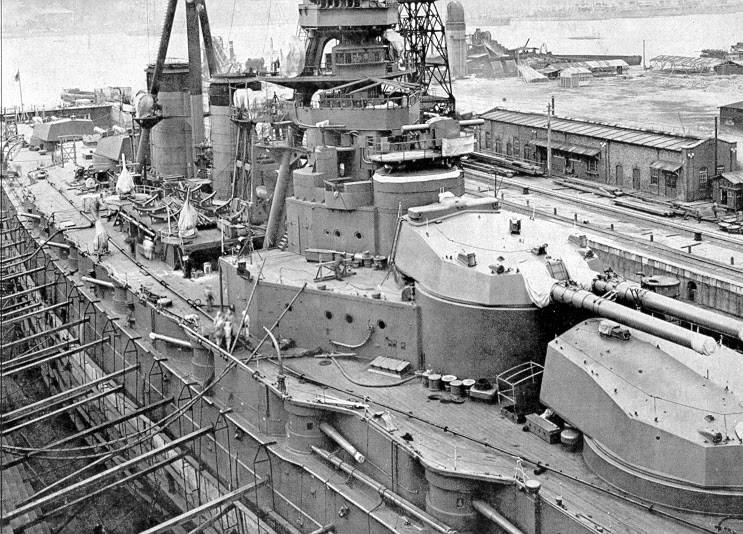
IJN kongo in dry dock(in background suspect was Nagato)

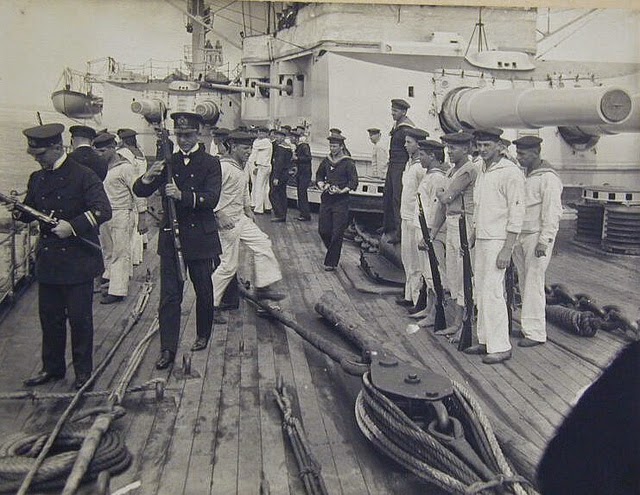
 IJN Mikasa in Drydock
 it can be said Admiral togo was Ruthless and almost he said is copied from Admiral Nelson
 In this photo we can see clearly 6 inch gun and 12 Pounder




 state of Mississippi seal


