|
28 January Incident
Second Sino-Japanese War
World War II, Pacific War:
- Attack on Pearl Harbor
- Invasion of Rabaul
- Bombing of Darwin
- Invasion of Java
- Battle of Midway
-
-
Design and construction
Kaga was laid down as a Tosa-class battleship, and was launched on 17 November 1921 at the Kawasaki Heavy Industries shipyard in Kobe. On 5 February 1922 both Tosa-class ships were canceled and scheduled to be scrapped under the terms of the Washington Naval Treaty.
The Treaty authorized conversion of two battleship or battlecruiser
hulls into aircraft carriers of up to 33,000 long tons (34,000 t)
standard displacement. The incomplete battlecruisers Amagi and Akagi were initially selected, but the Great Kantō Earthquake of 1923 damaged Amagi 's hull beyond economically feasible repair, and Kaga was selected as her replacement. The formal decision to convert Kaga
to an aircraft carrier was issued 13 December 1923, but no work took
place until 1925 as new plans were drafted and earthquake damage to the Yokosuka Naval Arsenal
was repaired. She was officially commissioned on 31 March 1928, but
this signified only the beginning of sea trials. She joined the Combined Fleet (Rengō Kantai) on 30 November 1929 as the IJN's third carrier to enter service, after Hōshō (1922) and Akagi (1927).
Kaga was completed with a length of 238.5 meters (782 ft 6 in) overall. She had a beam of 31.67 meters (103 ft 11 in) and a draft
at full load of 7.92 meters (26 ft 0 in). She displaced 26,900 long
tons (27,300 t) at standard load, and 33,693 long tons (34,234 t) at
full load, nearly 6,000 long tons (6,100 t) less than her designed
displacement as a battleship. Her complement totaled 1340 crewmembers.
-
Flight deck arrangements

Kaga as completed, with all three flight decks visible
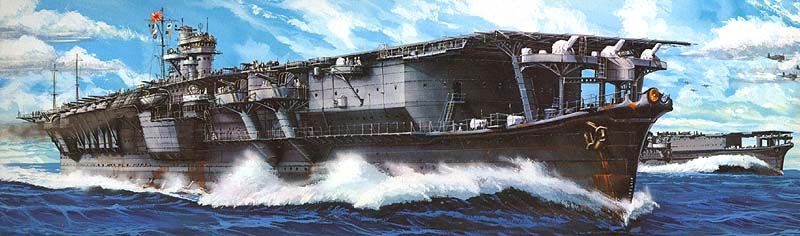
Kaga, like Akagi, was completed with three superimposed
flight decks, the only carriers ever to be designed so. The British
carriers converted from "large light cruisers", HMS Glorious, HMS Courageous, and HMS Furious,
each had two flight decks, but there is no evidence that the Japanese
copied the British model. It is more likely that it was a case of
convergent evolution to improve launch and recovery cycle flexibility by allowing simultaneous launch and recovery of aircraft. Kaga
's main flight deck was 171.2 meters (561 ft 8 in) long, her middle
flight deck was only about 15 meters (49 ft 3 in) long and started in
front of the bridge, and her lower flight deck was approximately 55
meters (180 ft 5 in) long. The utility of her middle flight deck was
questionable as it was so short that only some of the lightly loaded
aircraft could use it, even in an era when the aircraft were much
lighter and smaller than they were during World War II.
At any rate the ever-increasing growth in aircraft performance, size
and weight during the 1930s meant that even the bottom flight deck was
no longer able to accommodate the take-off roll required for the new
generations of aircraft being fielded and it was plated over when the
ship was modernized in the mid-1930s. Kaga 's main flight deck was completely flat until a conning tower was added during the modernization.
As completed, the ship had two main hangar decks and a third
auxiliary hangar with a total capacity of 60 aircraft. The hangars
opened onto the middle and lower flight decks to allow aircraft to take
off directly from the hangars while landing operations were in progress
on the main flight deck above. No catapults were fitted. Her forward aircraft lift
was offset to starboard and 10.67 by 15.85 meters (35.0 by 52.0 ft) in
size. Her aft lift was on the centerline and 12.8 by 9.15 meters (42 ft
0 in by 30 ft 0 in). Her arresting gear was a French transverse system as used on their aircraft carrier Béarn and known as the Model Fju (Fju shiki) in the Japanese service.
As originally completed, Kaga carried an air group of 28 Mitsubishi B1M3 torpedo bombers, 16 Nakajima A1N fighters and 16 Mitsubishi 2MR reconnaissance aircraft.
Armament and armor

Kaga 's fitting-out
in 1928. This stern view shows the long funnel extending aft below the
flight deck, and three 8-inch (200 mm) guns in casemates.
Kaga was armed with ten 20 cm/50 3rd Year Type guns: one twin-gun Model B turret on each side of the middle flight deck and six in casemates aft. They fired 110-kilogram (240 lb) projectiles at a rate of three to six rounds per minute with a muzzle velocity
of 870 m/s (2,900 ft/s); at 25°, they had a maximum range between
22,600 and 24,000 m (24,700 and 26,200 yd). The Model B turrets were
nominally capable of 70° elevation to provide additional anti-aircraft
(AA) fire, but in practice the maximum elevation was only 55°. The slow
rate of fire and the fixed 5° loading angle minimized any real
anti-aircraft capability.
This heavy gun armament was provided in case she was surprised by enemy
cruisers and forced to give battle, but her large and vulnerable flight
deck, hangars, and other features made her more of a target in any
surface action than a fighting warship. Carrier doctrine was still
evolving at this time and the impracticability of carriers engaging in
gun duels had not yet been realized.
She was given an anti-aircraft armament of six twin 12-centimeter (4.7 in) 45-caliber 10th Year Type Model A2 gun mounts fitted on sponsons below the level of the funnels, where they could not fire across the flight deck, three mounts per side. These guns fired 20.3-kilogram (45 lb) projectiles at a muzzle velocity
of 825–830 m/s (2,707–2,723 ft/s); at 45° this provided a maximum range
of 16,000 meters (17,000 yd), and they had a maximum ceiling of 10,000
meters (33,000 ft) at 75° elevation. Their effective rate of fire was 6
to 8 rounds per minute. She had two Type 89 directors to control her 20 cm guns and two Type 91 manually powered anti-aircraft directors (Kōshaki) to control her 12 cm guns.
Kaga 's waterline armored belt was reduced from 280 to 152 mm (11.0 to 6.0 in) during her reconstruction and the upper part of her torpedo bulge was given 127 mm (5.0 in) of armor. Her deck armor was also reduced from 102 to 38 mm (4.0 to 1.5 in).[13]
Propulsion
When Kaga was being designed the problem of how to deal with
exhaust gases in carrier operations had not been resolved. The swiveling
funnels of Hōshō had not proved successful and wind-tunnel testing had not provided an answer. As a result, Akagi and Kaga were given different exhaust systems to evaluate in real-world conditions. Kaga
's funnel gases were collected in a pair of long horizontal ducts which
discharged at the rear of each side of the flight deck, in spite of
predictions by a number of prominent naval architects that they would
not keep the hot gases away from the flight deck. The predictions proved
to be correct, not least because Kaga was slower than the Akagi
which allowed the gases to rise and interfere with landing operations.
Another drawback was that the heat of the gases made the crew's quarters
located on the side of the ship by the funnels almost uninhabitable.
Kaga was completed with four Kawasaki Brown-Curtis geared turbines with a total of 91,000 shaft horsepower (68,000 kW) on four shafts. As a battleship her expected speed had been 26.5 knots
(49.1 km/h; 30.5 mph), but the reduction in displacement from 39,900 to
33,693 long tons (40,540 to 34,234 t) allowed this to increase to 27.5
knots (50.9 km/h; 31.6 mph), as demonstrated on her sea trials on 15 September 1928. She had twelve Kampon Type B (Ro) boilers with a working pressure of 20 kg/cm2 (2,000 kPa; 280 psi),
although only eight were oil-fired. The other four used a mix of oil
and coal. She carried 8,000 long tons (8,128 t) of fuel oil and 1,700
long tons (1,727 t) of coal to give her a range of 8,000 nautical miles (15,000 km; 9,200 mi) at 14 knots (26 km/h; 16 mph).
Early service and development of carrier doctrine

Kaga conducting air operations in 1930. On the upper deck are
Mitsubishi B1M torpedo bombers preparing for takeoff. Nakajima A1N Type 3
fighters are parked on the lower deck forward.
On 1 December 1931 Kaga was assigned as the flagship of the First Carrier Division under the command of Rear Admiral Takayoshi Katō. The First Carrier Division, along with Hōshō, departed for Chinese waters on 29 January 1932 to support Imperial Japanese Army troops during the Shanghai Incident as part of the IJN's 3rd Fleet. The B1M3s carried by Kaga and Hōshō were the main bombers used during the brief combat over Shanghai.
Kaga 's aircraft, operating from both the carrier and a
temporary base at Kunda Airfield in Shanghai, flew missions in support
of Japanese ground forces throughout February 1932. During one of these
missions three of Kaga 's Nakajima A1N2 fighters, including one piloted by future ace Toshio Kuroiwa,
escorting three Mitsubishi B1M3 torpedo bombers, scored the IJN's first
air-to-air combat victory on 22 February when they shot down a Boeing P-12 flown by an American volunteer pilot.[ Kaga
returned to home waters upon the declaration of the cease-fire on 3
March and resumed fleet training with the rest of the Combined Fleet.[21]
At this time, the IJN's developing carrier doctrine was still in its earliest stages. Kaga
and the IJN's other carriers were initially given roles as tactical
force multipliers supporting the fleet's battleships in the IJN's "decisive battle" doctrine. In this role, Kaga
's aircraft were to attack enemy battleships with bombs and torpedoes.
Aerial strikes against enemy carriers were later, beginning around
1932–1933, deemed of equal importance in order to establish air superiority
during the initial stages of battle. The essential component in this
strategy was that the Japanese carrier aircraft must be able to strike
first with a massed, preventive
aerial attack. As a result, in fleet training exercises the carriers
began to operate together in front of or with the main battle line. The
new strategy emphasized maximum speed from both the carriers and the
aircraft they carried as well as larger aircraft with greater range.
Thus, longer flight decks on the carriers were required in order to
handle the newer, heavier aircraft which were entering service.
Kaga was soon judged inferior to Akagi because of her slower speed, smaller flight deck (64 feet (19.5 m) shorter), and problematic funnel arrangement. Because of Kaga 's perceived limitations, she was given priority over Akagi for modernization. Kaga
was relegated to reserve status on 20 October 1933 to begin a second
major reconstruction, with an official start date of 25 June 1934.
Reconstruction
During her second reconstruction Kaga 's two lower flight
decks were converted into hangars and, along with the main flight deck,
were extended to the bow. This increased the flight deck length to
248.55 meters (815 ft 5 in) and raised aircraft capacity to 90 (72
operational and 18 in storage). A third elevator forward, 11.5 by 12 meters (37 ft 9 in × 39 ft 4 in), serviced the extended hangars. Bomb and torpedo
elevators were modified to deliver their munitions directly to the
flight deck. Her arrester gear was replaced by a Japanese-designed Type 1
system. A small starboard island superstructure was also installed.

Kaga after reconstruction showing the new, full-length flight deck above the wide battleship hull.
Her power plant was completely replaced as were her propellers. New
Kampon multi-stage geared turbines were fitted that increased her power
from 91,000 to 127,400 shp (67,859 to 95,002 kW) during trials. Each had
a high-pressure, a low-pressure, and a cruising turbine coupled to a
single shaft. Her boilers were replaced by eight improved oil-burning
models of the Kampon Type B (Ro) with a working pressure of 22 kg/cm2
(2,157 kPa; 313 psi) at a temperature of 300 °C (572 °F). The hull was
lengthened by 10.3 meters (33 ft 10 in) at the stern to reduce drag and
she was given another torpedo bulge above the side armor abreast the
upper part of the existing bulge to increase her beam and lower her
center of gravity as a result of lessons learned from the Tomozuru Incident
in early 1934. This raised her standard displacement significantly,
from 26,900 to 38,200 long tons (27,332 to 38,813 t). The extra power
and the extra displacement roughly offset each other and her speed
increased by less than a knot, up to 28.34 knots (52.49 km/h; 32.61 mph)
on trials. Her fuel storage was increased to 7,500 long tons (7,620 t)
of fuel oil which increased her endurance to 10,000 nmi
(18,520 km; 11,510 mi) at 16 knots (30 km/h; 18 mph). The lengthy
funnel ducting was replaced by a single downturned starboard funnel
modeled on that used by the Akagi with a water-cooling system for
the exhaust gasses and a cover that could be raised to allow the
exhaust gasses to escape if the ship developed a severe list and the
mouth of the funnel touched the sea. The space freed up by the removal
of the funnel ducts was divided into two decks and converted into living
quarters for the expanded air group. The carrier's complement increased to 1708 crewmembers.
The two twin turrets on the middle flight deck were removed and four
new 20 cm/50 3rd Year Type No. 1 guns in casemates were added forward.
Her 12 cm anti-aircraft guns were replaced by eight 12.7-centimeter
(5.0 in)/40 Type 89 guns in twin mounts. They fired 23.45-kilogram
(51.7 lb) projectiles at a rate between 8 and 14 rounds per minute at a muzzle velocity
of 700–725 m/s (2,300–2,380 ft/s); at 45°, this provided a maximum
range of 14,800 meters (16,200 yd), and a maximum ceiling of 9,400
meters (30,800 ft). Their sponsons were raised one deck to allow them some measure of cross-deck fire. Eleven twin 25 mm Type 96 gun mounts were added, also on sponsons. They fired .25-kilogram (0.55 lb) projectiles at a muzzle velocity
of 900 m/s (3,000 ft/s); at 50°, this provided a maximum range of 7,500
meters (8,202 yd), and an effective ceiling of 5,500 meters
(18,000 ft). The maximum effective rate of fire was only between 110 and
120 rounds per minute due to the frequent need to change the
fifteen-round magazines. Six 6.5-millimeter (0.26 in) Type 11 machine guns were also carried. Six Type 95 directors were fitted to control the new 25 mm guns, but Kaga retained her outdated Type 91 anti-aircraft directors.
Several major weaknesses in Kaga 's design were not rectified. Kaga
's aviation fuel tanks were incorporated directly into the structure of
the carrier, meaning that shocks to the ship, such as those caused by
bomb or shell hits, would be transmitted directly to the tanks,
resulting in cracks or leaks. Also, the fully enclosed structure of the
new hangar decks made fire suppression difficult, at least in part
because fuel vapors could accumulate in the hangars. Adding to the
danger was the requirement from the Japanese carrier doctrine that
aircraft be serviced, fueled, and armed whenever possible on the hangar
decks rather than on the flight deck. In addition, the carrier's hangar
and flight decks carried little armor protection. Furthermore, there was
no redundancy in the ship's fire-extinguishing systems. These
weaknesses would later be crucial factors in the loss of the ship.
Sino-Japanese War
Kaga returned to service in 1935 and was assigned to the Second Carrier Division. The carrier embarked a new set of aircraft, including 16 Nakajima A2N Type 90 fighters, 16 Aichi D1A Type 94 dive bombers, and 28 Mitsubishi B2M Type 89 torpedo bombers.

Kaga conducts air operations in 1937. On deck are Nakajima A2N, Aichi D1A, and Mitsubishi B2M aircraft.
The renewal of hostilities with China at the Marco Polo Bridge in July 1937 found Kaga in home waters. The ship's fighter squadron completed training at Ōmura, Nagasaki then helped escort ships taking army reinforcements from Japan to China. On 15 August, along with Hōshō and Ryūjō, the ship took station in the East China Sea
as part of the 3rd Fleet and began supporting Japanese military
operations along the central China coast around Shanghai and further
inland.
Kaga aircraft fought their first battle on 16 August 1937 when six Type 90 fighters engaged four Chinese aircraft over Kiangwan, shooting down three without loss. Between 17 August and 7 September, Kaga 's Type 90 and two Mitsubishi A5M Type 96 fighters, which joined the carrier on 22 August, engaged Chinese aircraft on several more occasions. Kaga 's fighter pilots claimed to have shot down 10 Chinese aircraft in these encounters without loss. On 17 August twelve of the carrier's bombers attacked Hangchow without fighter escort and 11 of them were shot down by Chinese fighters.Beginning on 15 September, six Type 90 and six Type 96 fighters, 18
dive bombers, and 18 torpedo bombers were temporarily deployed to Kunda
Airfield from the ship to support land operations.
On 26 September the carrier went to Sasebo for reprovisioning. At Sasebo, the carrier received new replacement aircraft including 32 Yokosuka B4Y Type 96 carrier attack planes (torpedo bombers), 16 Aichi D1A2 Type 96 carrier bombers (dive bombers), and 16 more Type 96 fighters. Several Nakajima A4N Type 95 fighter aircraft augmented the carrier's fighter group at an unspecified later date.
Kaga returned to the front in early October 1937, and except
for two brief trips to Sasebo, remained off China until December 1938.
Using Taiwan (then part of the Empire of Japan) as its base, the carrier steamed 29,048 nautical miles (53,797 km; 33,428 mi) supporting military operations from the South and East China Seas. During that time, Kaga
bombers supported army operations by attacking enemy railroad bridges,
airfields, and transportation vehicles. The carrier's fighter pilots
claimed to have destroyed at least 17 Chinese aircraft in aerial combat
while losing five aircraft themselves. On 12 December 1937 Kaga aircraft participated in the Panay incident.
Kaga entered the shipyard on 15 December 1938, where her
arrester gear was replaced by a Type 3 system and her bridge was
modernized. The flight deck and hangar areas were enlarged, increasing
the carrier's aircraft capacity. The ship was completely overhauled from
15 November 1939 to 15 November 1940 before returning to active
service. In the meantime, a new generation of aircraft had entered
service and Kaga embarked 12 Mitsubishi A5M fighters, 24 Aichi D1A dive bombers and 36 Yokosuka B4Y torpedo bombers. Another 18 aircraft were carried in crates as spares.
The Japanese carriers' experiences off China had helped further
develop the IJN's carrier doctrine. One lesson learned in China was the
importance of concentration and mass in projecting naval air power
ashore. Therefore, in April 1941 the IJN formed the First Air Fleet to combine all of its fleet carriers under a single command. On 10 April 1941 Kaga was assigned to the First Carrier Division with Akagi as part of the new carrier fleet, which also included the Second and Fifth
carrier divisions. The IJN centered its doctrine on air strikes that
combined the air groups within carrier divisions, rather than each
individual carrier. When more than one carrier division was operating
together, the divisions' air groups were combined with each other. This
doctrine of combined, massed, carrier air attack groups was the most
advanced of its kind of all the world's navies. The IJN, however,
remained concerned that concentrating all of its carriers together would
render them vulnerable to being wiped out all at once by a massive
enemy air or surface strike. Thus, the IJN developed a compromise
solution in which the fleet carriers would operate closely together
within their carrier divisions but the divisions themselves would
operate in loose rectangular formations, with approximately 7,000 metres
(7,700 yd) separating the carriers from each other.
Although the concentration of so many fleet carriers into a single
unit was a new and revolutionary offensive strategic concept, the First
Air Fleet suffered from several defensive deficiencies which gave it, in
Mark Peattie's words, a "'glass jaw': it could throw a punch but couldn't take one."
Japanese carrier anti-aircraft guns and associated fire control systems
had several design and configuration deficiencies which limited their
effectiveness. The IJN's fleet combat air patrol (CAP) consisted of too few fighter aircraft and was hampered by an inadequate early warning system, including a lack of radar.
Poor radio communications with the fighter aircraft inhibited effective
command and control of the CAP. The carriers' escorting warships were
deployed as visual scouts in a ring at long range, not as close
anti-aircraft escorts, as they lacked training, doctrine, and sufficient
anti-aircraft guns. These deficiencies would eventually doom Kaga and other First Air Fleet carriers.
World War II
Pearl Harbor

Kaga (foreground), with Zuikaku (background), heads towards Pearl Harbor sometime between 26 November and 7 December 1941.
In November 1941 the IJN's Combined Fleet, under Isoroku Yamamoto,
prepared to participate in Japan's initiation of a formal war with the
United States by conducting a preemptive strike against the United States Navy's Pacific Fleet base at Pearl Harbor, Hawaii. On 17 November Kaga, under the command of Captain Jisaku Okada,
loaded 100 torpedoes at Saeki Bay, Hiroshima; these torpedoes were
specially designed for use in the shallow waters of the Pearl Harbor
anchorage. On 19 November, Kaga and the rest of the Combined Fleet's mobile strike force (Kido Butai), under Chuichi Nagumo and including six fleet carriers from the First, Second, and Fifth Carrier Divisions, assembled in Hitokappu Bay at Etorofu Island.
The fleet departed Etorofu on 26 November and followed a course across
the north-central Pacific to avoid commercial shipping lanes.
For the attack on Pearl Harbor, Kaga carried a total of 18 Mitsubishi A6M Zero fighters, 27 Nakajima B5N torpedo bombers and 27 Aichi D3Adive bombers, plus three crated aircraft of each type for the operation. During the morning of 7 December 1941 Kaga aircraft participated in both First Air Fleet strikes launched against Oahu from a position 230 nautical miles (430 km) north of the island. In the first strike of 213 total aircraft, 26 Kaga
B5N carrier attack bombers attacked the American ships at anchor with
bombs and torpedoes, escorted by nine Zeros. In the second strike of 170
aircraft, 26 Kaga D3A dive bombers targeted the airfield at Ford Island
in the middle of the harbor while nine Zeros provided escort and
attacked aircraft on the ground. A total of five B5N, four Zeros and six
D3A from the ship were lost during the two strikes, along with their
aircrews, a total of 31 personnel. Kaga 's bomber and torpedo crews claimed hits on the battleships Nevada, Oklahoma, Arizona, California, West Virginia, and Maryland. The ship's fighter pilots claimed to have shot down one US aircraft and destroyed 20 on the ground. Upon completion of the attack, the First and Fifth Carrier divisions, including Kaga, returned immediately to Japan.
Pacific conquest
In January 1942, together with the rest of the First and Fifth Carrier Division carriers and staging out of Truk (now Chuuk) in Micronesia, Kaga supported the invasion of Rabaul in the Bismarck Islands. Kaga provided 27 bomb-carrying B5N and 9 Zeros for the initial airstrike on Rabaul on 20 January 1942, during which one B5N was shot down by anti-aircraft fire. The First Carrier Division attacked Allied positions at nearby Kavieng the following day, of which Kaga contributed nine Zeros and sixteen D3As. On the 22nd Kaga 's D3As and Zeros again attacked Rabaul and two dive bombers had to make emergency landings, but the crews were rescued. Kaga returned to Truk on 25 January and Rabaul and Kavieng were successfully occupied by Japanese forces by February.
On 9 February Kaga hit a reef at Palau after she had unsuccessfully sortied against American carrier forces attacking the Marshall Islands on 1 February. The damage reduced the carrier's speed to 18 knots. After temporary repairs, she continued to the Timor Sea, where on 19 February 1942 she, with the other carriers of the First and Second Carrier Divisions, launched air strikes against Darwin, Australia from a point 100 nautical miles (190 km) southeast of the easternmost tip of Timor. Kaga
contributed 27 B5Ns (carrying bombs), 18 D3A, and 9 Zeros to the
attack, which caught the defenders by surprise. Eight ships were sunk,
including the destroyer Peary, and fourteen more were damaged, at a cost of only one of Kaga 's B5Ns. In March 1942, Kaga, based out of Staring-baai, helped cover the invasion of Java, although her only contribution appears to have been aircraft for the 5 March 1942 airstrike on Tjilatjap. In that attack Kaga
contributed 27 bomb-carrying B5N escorted by nine Zeros. The attacking
aircraft bombed merchant ships in the harbor, sinking eight of them, and
attacked anti-aircraft batteries and a warehouse without loss. Most of
the Allied forces in the Dutch East Indies surrendered to the Japanese
later in March. Kaga was unable to participate in the Indian Ocean raid in April because of the damage she had received in February. Instead, she sailed for Sasebo on 15 March for repairs, entering drydock on 27 March. The repairs were completed on 4 May.
Battle of Midway
.
Midway raid

Lieutenant Shōichi Ogawa led Kaga 's dive bomber group in the attack on Midway Island. Ogawa was fatally wounded later the same day when Kaga was hit by American dive bombers.
Concerned by the US carrier strikes in the Doolittle, Marshall Islands, and Lae-Salamaua
raids, Yamamoto determined to force the US Navy into a showdown to
eliminate the American carrier threat. Yamamoto decided to invade and
occupy Midway Island,
which he was sure would draw out the American carrier forces to battle.
The Midway invasion was codenamed by the Japanese as Operation MI.
In support of MI, on 27 May 1942, Kaga departed the Inland Sea with the Combined Fleet on her final mission, in the company of carriers Akagi, Hiryū, and Sōryū which constituted the First and Second Carrier Divisions. Her aircraft complement was 27 Zeros, 20 D3As, and 27 B5Ns. With the fleet positioned 250 nautical miles (460 km) northwest of Midway Island at dawn on 4 June 1942, Kaga
contributed eighteen D3As, commanded by Lieutenant Shōichi Ogawa,
escorted by nine Zeros to the strike against the island. The carrier's
B5Ns were armed with torpedoes and kept ready in case enemy ships were
discovered during the Midway raid. One each of the D3As and Zeros was
shot down by AA fire over Midway, and another four D3As were damaged. Kaga 's Zero pilots claimed to have shot down 12 US aircraft over Midway Island. One Kaga B5N was launched to augment the fleet's reconnaissance of the surrounding ocean. The carrier also put up two Zeros on CAP.[49][55]
Another five Zeros reinforced her CAP at 07:00 and the seven fighters
helped to defend the Kido Butai from the first US air attackers from
Midway Island at 07:10. Unknown to the Japanese, the US Navy had divined
the Japanese MI plan from signals intelligence and had prepared an ambush using its three available carriers, positioned northeast of Midway.
At 07:15 Admiral Nagumo ordered the B5Ns still on Kaga and Akagi
rearmed with bombs for another attack on Midway itself. This process
was limited by the number of ordnance carts used to handle the bombs and
torpedoes
and the limited number of ordnance elevators. Thus, the torpedoes could
not be struck below until after all the bombs were moved up from their magazine,
assembled and mounted on the aircraft. This process normally took about
an hour and a half; more time would be required to bring the aircraft
up to the flight deck and warm up and launch the strike group. Around
07:40 Nagumo reversed his order when he received a message that American
carriers had been spotted. At 07:30 Kaga recovered three of her CAP.
Sinking
Kaga 's four remaining CAP fighters were in the process of landing when 16 Marine SBD Dauntless dive-bombers from Midway, led by Lofton R. Henderson, attacked Hiryu around 07:55 without result. Five Zeros were launched at 08:15 and three intercepted a dozen Midway-based United States Army B-17 Flying Fortresses
attempting to bomb the three other carriers from 20,000 feet (6,100 m),
but only limited damage was inflicted on the heavy bombers, although
their attacks all missed. Five D3As also joined the CAP around this
time. Another trio of Zeros were launched at 08:30. Kaga began
landing her returning Midway strike force aboard around 08:35 and was
finished by 08:50; one Zero pilot died after crash-landing his aircraft.
The five Zeros launched at 08:15 were recovered aboard at 09:10 and
replaced by six more Zeros launched at 09:20. They intercepted the first
US carrier aircraft to attack, TBD Devastator torpedo-bombers of VT-8 from the US carrier Hornet at 09:22, and shot down all 15, leaving only a single survivor, George H. Gay, Jr., treading water. Shortly thereafter, 14 Devastators from VT-6 from the US carrier Enterprise, led by Eugene E. Lindsey, were spotted. They tried to sandwich Kaga, but the CAP, reinforced by another six Zeros launched by Kaga at 10:00, shot down all but four of the Devastators, and the carrier dodged the torpedoes.

Dive bomber pilots from Enterprise who helped fatally damage Kaga on 4 June. Ensign John Q. Roberts, who was shot down and killed by Kaga 's anti-aircraft guns, is standing at the far left of the photo. The bomb that killed Kaga 's senior officers on the bridge may have been dropped by Ensign James C. Dexter, standing third from the right.
Soon after the torpedo plane attacks, American carrier dive bombers
arrived over the Japanese carriers almost undetected and began their
dives. At 10:22, 25 SBD Dauntless dive-bombers from Enterprise, led by C. Wade McClusky, hit Kaga
with one 1,000-pound (450 kg) bomb and at least three 500-pound
(230 kg) bombs. The first landed near her rear elevator and set the
berthing compartments on fire, and the next bomb hit the forward
elevator and penetrated the upper hangar, setting off explosions and
fires among the armed and fueled planes on her hangar deck. Captain
Okada and most of the ship's senior officers were killed by the third
bomb, which hit the bridge.The 1000-pound bomb hit amidships and penetrated the flight deck to
explode on the upper hangar. The explosions ruptured the ship's avgas
lines, damaged both her port and starboard fire mains and the emergency
generator powering her fire pumps, as well as knocking out the carbon dioxide fire suppression system.
Fueled by the avgas pouring onto the hangar deck, the fires detonated
the 80,000 pounds (36,000 kg) of bombs and torpedoes strewn across the
hangar deck in a series of catastrophic multiple fuel-air explosions
that blew out the hangar sides. At nearly the same time, dive bombers hit and fatally damaged Akagi and Sōryū.
Unable to contain her fires, Kaga 's survivors were taken off by the destroyers Hagikaze and Maikaze between 14:00 and 17:00. Around 19:25 she was scuttled by two torpedoes from Hagikaze and sank stern-first at position 30°20′N 179°17′W. Ensign Takeshi Maeda, an injured Kaga B5N aircrew member rescued by Hagikaze,
described the scene: "My comrade carried me up to the deck so I could
see the last moments of our beloved carrier, which was nearby. Even
though I was in pain tears started to run down my cheeks, and everyone
around me was crying; it was a very sad sight."
The carrier's crew suffered 811 fatalities, mainly among the aircraft
mechanics and armorers stationed on the hangar decks and the ship's
engineers, many of whom were trapped below in the boiler and engine
rooms by uncontrolled fires raging on the decks above them. Twenty-one
of the ship's aviators were killed. The loss of Kaga and the three other IJN carriers at Midway (Hiryū
was also sunk during the battle), with their aircraft and veteran
pilots, was a crucial strategic defeat for Japan and contributed
significantly to Japan's ultimate defeat in the war.
Wreck survey
In May 1999, the Nauticos Corporation, in partnership with the US Navy, discovered some wreckage from Kaga. They employed the research vessel Melville
during a survey of a fleet exercise area with the US Navy's recently
modified SEAMAP acoustic imaging system. A follow-on search by the USNS Sumner in September 1999 located the wreckage and took photos of it.
The wreckage included a 50-foot (15 m) long section of hangar bulkhead,
two 25 mm anti-aircraft gun tubs, and a landing light array. The
artifacts were at a depth of 17,000 feet (5,200 m). -

-
-


- Kaga (misidentified as Akagi) and Hiei (misidentified as Kongo) in
harbor, circa 1932-34; the ship at far right is a Takao-class heavy
cruiser
-
-
 -
- Battleship Yamashiro and carrier Kaga in Kobe Bay, Japan, 22-23 Oct 1930; they were gathering for a fleet review
-
-
-
-
-
-
-
-
|

 Imperial Japanese Navy


 Carrier Soryu fitting out at the Kure Naval Arsenal, Japan, early 1937
 D3A1 dive bombers preparing to take off from Akagi to attack Pearl
Harbor, US Territory of Hawaii, 7 Dec 1941; carrier Soryu in background
D3A1 dive bombers preparing to take off from Akagi to attack Pearl
Harbor, US Territory of Hawaii, 7 Dec 1941; carrier Soryu in background


 maybe this why japanese aircraft